Sale 10% Off Your First Order

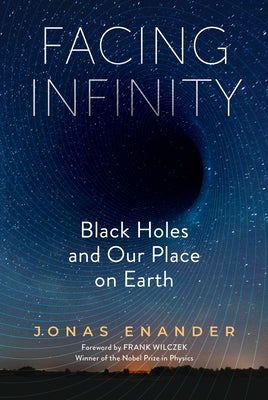
Humanity's relationship with black holes began in 1783 in a small English village, when clergyman John Michell posed a startling question: What if there are objects in space that are so large and heavy that not even light can escape them? Almost 250 years later, in April 2019, scientists presented the first picture of a black hole. Profoundly inspired by that image, physicist Jonas Enander has traveled the world to investigate how our understanding of these elusive celestial objects has evolved since the days of Michell.
With the particular goal of discovering our human connection to black holes, Enander visits telescopes and observatories, delves deeply into archives, and interviews over 20 world-leading experts, including several Nobel laureates. With Facing Infinity, he takes us on a spellbinding journey into the universe's greatest mystery, deciphers the most mind-bending science, and answers questions surrounding how black holes work, where they come from, and what role they play in the universe.
Along the way Enander discovers how our desire to understand black holes inadvertently paved the way for the invention of Wi-Fi and the calibration of our global navigation satellites, how astronomical discovery became entangled with colonial conflicts, and how our looking outward gave us critical evidence of the impact of climate change. Facing Infinity helps us appreciate and understand as never before these mysterious celestial objects and our surprising connections to them.
Frank Wilczek won the Nobel Prize in Physics in 2004 for work he did as a graduate student. He was among the earliest MacArthur fellows, and has won many awards both for his scientific work and his writing. He is the author of A Beautiful Question, The Lightness of Being, Fantastic Realities, Longing for the Harmonies, Fundamentals, and hundreds of articles in leading scientific journals. His "Wilczek's Universe" column appears regularly in The Wall Street Journal. Wilczek is the Herman Feshbach Professor of Physics at the Massachusetts Institute of Technology, founding director of the T. D. Lee Institute and chief scientist at the Wilczek Quantum Center in Shanghai, China, and a distinguished professor at Arizona State University and Stockholm University.