Sale 10% Off Your First Order

Elysium Illuminated is not a book of beliefs, theories, or metaphysical systems. Instead, it's a work of experiential inquiry that invites readers into a way of seeing that precedes explanation. Drawing on decades of direct exploration of non-physical reality, deep meditative states, and sustained phenomenological observation, Jürgen Ziewe offers a subtle and luminous investigation into the nature of consciousness, form, and meaning beyond the physical world.
Where his earlier work, Elysium Unveiled, mapped a wide range of post-physical environments and examined their psychological and ethical dimensions, Elysium Illuminated moves deeper still. This book doesn't aim to describe worlds; instead, it explores the conditions under which worlds arise. It's less concerned with what's "out there" and more with how experience itself becomes possible.
A central theme of the book is the idea that reality, both physical and non-physical, is not a fixed structure but a responsive field shaped by awareness, coherence, and participation. Ziewe approaches the astral not as a supernatural geography but as a resonant medium in which consciousness encounters itself in ever-refining forms. Some of these forms appear as landscapes, others as abstract states, and still others as pure presence without imagery. Each reveals something about how meaning arises from relationship rather than from structure.
A significant section of the book explores the role of nature, both earthly and non-physical, as a threshold experience. Ziewe reflects on how beauty is not merely decorative but perceptual: a direct recognition of coherence made visible. He questions whether nature exists beyond physical life as scenery or whether it emerges when consciousness itself becomes harmonised enough to allow form to appear. These reflections lead to a broader inquiry into whether non-physical reality may carry subtle tonal imprints of prehuman sentience, suggesting not a mythic history but a depth of participation that precedes individuality.
Throughout, Ziewe resists definitive claims, instead creating a field of recognition that allows readers to sense his insights rather than adopt them. His writing is contemplative, precise, and grounded in lived experience, aiming not to persuade but to attune.
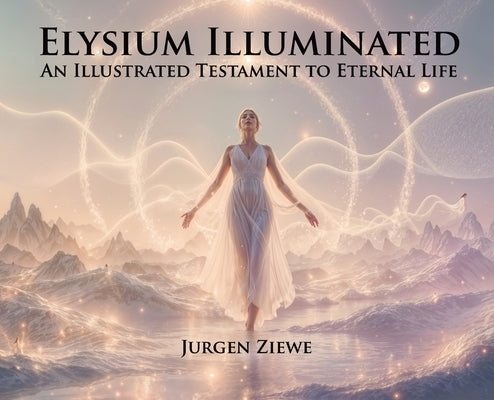
The book's main strength lies in the power of its detailed illustrations, which complement the text not just as illustrations but as illuminators and inspirations. They encourage readers to delve deeper into their own inner lives, exploring the possibility of connecting with profound archetypal memories hidden within.
Elysium Illuminated functions as a resonant text, inviting recall rather than instruction. It encourages a quieter mode of engagement, accompanying the reader rather than leading them. This makes the book accessible to spiritual explorers, meditators, experiencers, and anyone drawn to questions of consciousness without dogma.
Ultimately, Elysium Illuminated is not about what happens after death, but about what becomes visible when perception softens, deepens, and opens. It suggests that what we call "higher worlds" may not be elsewhere at all, but latent within awareness itself, waiting for the right conditions to emerge.