
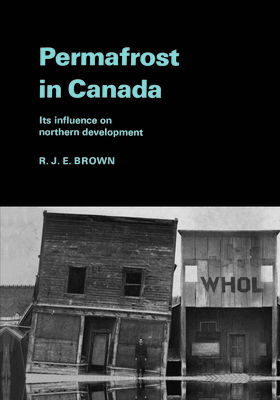
Permafrost in Canada: Its Influence on Northern Development - Paperback
by Roger Brown
$48.99
Quantity
01
Pay over time for orders over $35.00 with
Offers & Perks
Earn 48 points with this purchase
Added to your rewards balance after checkout.
100 points welcome bonus
Create an account and start with extra points.
Availability:In StockContributor:Roger BrownSeries:HeritageTheme:Topical/EcologyPublish date:12/15/1970Pages:246
Languages:EnglishPublisher:University of Toronto PressISBN-13:9781442651517ISBN-10:1442651512UPC:9781442651517Book Category:Nature, Science, Social ScienceBook Subcategory:Ecology, Earth Sciences, Regional StudiesBook Topic:GeographySize:10.00 x 7.00 x 0.52 inchesWeight:0.436Product ID:SCBX29GBQ6
Permafrost is the thermal condition of the earth's crust when
its temperature has been below 32 F continuously for a number of years. Half of Canada's land surface lies in the permafrost region--either in the continuous zone where the ground is frozen to a depth of hundreds of feet, or in the discontinuous zone where permafrost is thinner, and there are areas of unfrozen ground.The existence of permafrost causes problems for the development of the
northern regions of all countries extending into the Arctic. Mining operations are hindered by frozen ore which resists blasting and is difficult to thaw. Agriculture is restricted by the presence of permafrost near the ground surface which limits the soil available for plant growth.Engineering structures are also
affected by the low temperatures. Ice layers give soil a rock-like structure with high strength. However heat transmitted by buildings often causes the ice to melt, and the resulting slurry is unable to support the structure. Many settlements in northern Canada have examples of structural damage or failure caused by permafrost. In the construction and maintenance of railways, buildings, water and sewage lines, dams, roads, bridges, and airfields, normal techniques must often be modified at additional cost because of permafrost.For the last twenty-five years
scientific investigations and engineering projects have increased steadily in Canada's permafrost region, and it is now technically possible to build any structure or conduct any activity on the worst soils and under permafrost conditions.This comprehensive analysis of permafrost--its origin,
definition, and occurrence, and the effect it has on industry and agriculture--will be invaluable to the growing number of people working in the north and to those interested in its development.Languages:EnglishPublisher:University of Toronto PressISBN-13:9781442651517ISBN-10:1442651512UPC:9781442651517Book Category:Nature, Science, Social ScienceBook Subcategory:Ecology, Earth Sciences, Regional StudiesBook Topic:GeographySize:10.00 x 7.00 x 0.52 inchesWeight:0.436Product ID:SCBX29GBQ6
Roger J.E. Brown (1931-1980) studied geography at the University of Toronto and Clark University, receiving a PH.D. from the latter in 1961. Starting in 1953 he worked with the National Research Council of Canada in the Northern Research Group, Soil Mechanics Section, Division of Building Research. As an associate research officer, he studied the distribution of permafrost and the physical factors affecting this distribution. He was research advisor to the permafrost subcommittee of the associate committee on geotechnical research and a member of the associate committee on quaternary research, both of the NRC, and a fellow of the Arctic Institute of North America. He visited many parts of Northern Canada.
Publisher: University of Toronto Press
Contributor(s)
Author
Free shipping on orders over $75. Standard shipping takes 3-7 business days. Eligible items may be returned within 30 days of delivery. Conditions apply.