
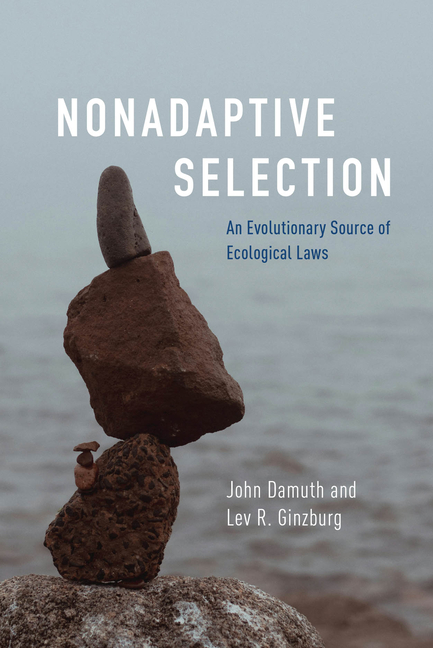
Nonadaptive Selection: An Evolutionary Source of Ecological Laws - Paperback
$36.99
Quantity
01
Pay over time for orders over $35.00 with
Offers & Perks
Earn 36 points with this purchase
Added to your rewards balance after checkout.
100 points welcome bonus
Create an account and start with extra points.
Availability:In StockContributor:John Damuth, Lev R. GinzburgTheme:Topical/EcologyPublish date:7/10/2025Pages:240
Languages:EnglishPublisher:University of Chicago PressISBN-13:9780226838571ISBN-10:0226838579UPC:9780226838571Book Category:ScienceBook Subcategory:Life SciencesBook Topic:Ecology, EvolutionSize:8.90 x 6.00 x 0.70 inchesWeight:0.477Product ID:SCTKE7EB4N
The first comprehensive explanation of a widely applicable but underappreciated mechanism of evolution operating at higher levels of organization than the individual. In this important treatise, ecologists and evolutionary biologists John Damuth and Lev R. Ginzburg identify a specific evolutionary process in biology, which they call nonadaptive selection. The idea is simple, but the implications are profound. Nonadaptive selection, as they use the term, is selection among biological entities (as is natural selection) but is based on the fitness effects of structural properties intrinsic to the entities under selection rather than on interactions between traits and a local shared environment. In other words, features of systems that evolve by nonadaptive selection do not adapt to local environmental conditions; rather, this selective process increases the long-term stability of the focal systems independent of local conditions. Nonadaptive selection may be of particular value in explaining broad, persistent patterns in multispecies biological units where adaptive evolution may be weak or poorly defined. Examples include Damuth's Law, the equivalence of energy use among animal species across a wide range of body sizes; the ratio-dependent, or Arditi-Ginzburg, predation conjecture; the consistency of allometric scaling powers; the shortness of trophic chains; and the prevalence of certain types of three-species trophic structures across ecosystems. Damuth and Ginzburg see nonadaptive selection underlying patterns of ecological allometries, community structure, and species interactions, with some implications for macroevolution. Moreover, they find a surprising relationship between these nonadaptive processes and biological laws. They do not advocate the reorientation of any existing research programs but present nonadaptive selection as an additional conceptual framework that may be useful to add to ecology and evolution.
Languages:EnglishPublisher:University of Chicago PressISBN-13:9780226838571ISBN-10:0226838579UPC:9780226838571Book Category:ScienceBook Subcategory:Life SciencesBook Topic:Ecology, EvolutionSize:8.90 x 6.00 x 0.70 inchesWeight:0.477Product ID:SCTKE7EB4N
John Damuth (1952-2024) was a senior research scientist in the Department of Ecology, Evolution, and Marine Biology at the University of California, Santa Barbara. Lev R. Ginzburg is professor emeritus in the Department of Ecology and Evolution at Stony Brook University. Among his books are the coauthored How Species Interact: Altering the Standard View on Trophic Ecology and Ecological Orbits: How Planets Move and Populations Grow.
Publisher: University of Chicago Press
Contributor(s)
Authors
Free shipping on orders over $75. Standard shipping takes 3-7 business days. Eligible items may be returned within 30 days of delivery. Conditions apply.