
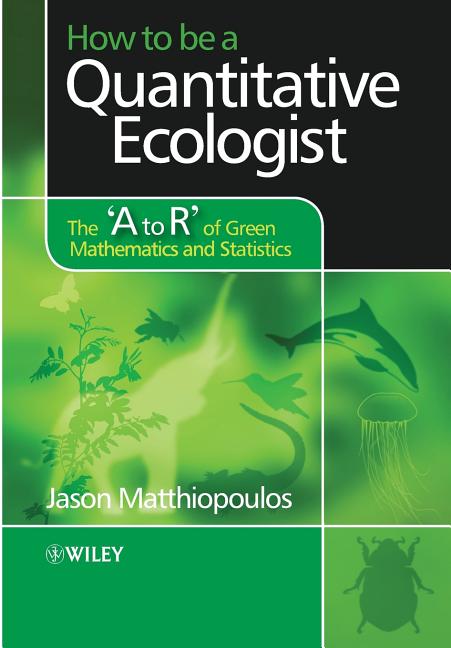
How to Be a Quantitative Ecologist: The 'a to R' of Green Mathematics and Statistics - Paperback
Pay over time for orders over $35.00 with
Offers & Perks
Earn 64 points with this purchase
Added to your rewards balance after checkout.
100 points welcome bonus
Create an account and start with extra points.
How to be a Quantitative Ecologist: The 'A to R' of Green Mathematics and Statistics
Ecological research is becoming increasingly quantitative, yet students often opt out of courses in mathematics and statistics, unwittingly limiting their ability to carry out research in the future. This textbook provides a practical introduction to quantitative ecology for students and practitioners who have realised that they need this opportunity.
The text is addressed to readers who haven't used mathematics since school, who were perhaps more confused than enlightened by their undergraduate lectures in statistics and who have never used a computer for much more than word processing and data entry. From this starting point, it slowly but surely instils an understanding of mathematics, statistics and programming, sufficient for initiating research in ecology. The book's practical value is enhanced by extensive use of biological examples and the computer language R for graphics, programming and data analysis.
Key Features:
- Provides a complete introduction to mathematics statistics and computing for ecologists.
- Presents a wealth of ecological examples demonstrating the applied relevance of abstract mathematical concepts, showing how a little technique can go a long way in answering interesting ecological questions.
- Covers elementary topics, including the rules of algebra, logarithms, geometry, calculus, descriptive statistics, probability, hypothesis testing and linear regression.
- Explores more advanced topics including fractals, non-linear dynamical systems, likelihood and Bayesian estimation, generalised linear, mixed and additive models, and multivariate statistics.
- R boxes provide step-by-step recipes for implementing the graphical and numerical techniques outlined in each section.
How to be a Quantitative Ecologist provides a comprehensive introduction to mathematics, statistics and computing and is the ideal textbook for late undergraduate and postgraduate courses in environmental biology.
"With a book like this, there is no excuse for people to be afraid of maths, and to be ignorant of what it can do."
--Professor Tim Benton, Faculty of Biological Sciences, University of Leeds, UK
Contributor(s)
Author
Free shipping on orders over $75. Standard shipping takes 3-7 business days. Eligible items may be returned within 30 days of delivery. Conditions apply.