
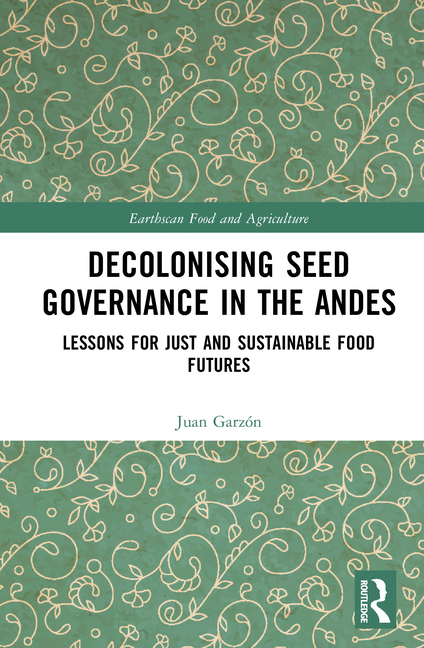
Decolonising Seed Governance in the Andes: Lessons for Just and Sustainable Food Futures - Hardcover
Pay over time for orders over $35.00 with
Offers & Perks
Earn 231 points with this purchase
Added to your rewards balance after checkout.
100 points welcome bonus
Create an account and start with extra points.
Focusing on the Latin American Andes region, this book examines how emerging decolonial narratives, practices, and rules have opened possibilities for structural change in agri-food systems.
The book argues that the contemporary global agri-food crisis is the outcome of a modern and colonial worldview that has reached its limits. Addressing it requires deep transformations related to power, values, and ways of being and knowing. Over the last thirty-five years, the Andean region has experienced a 'transmodern turn', planting the seeds for deep transitions towards alternatives like Buen Vivir while challenging established global north paradigms. Using agricultural seeds as the site of analysis, the book reveals how struggles over knowledge, authority, and legitimacy are condensed in everyday practices of seed production, exchange, and regulation. It traces how Andean Seed Guardian Networks engaged the state to gradually reshape seed systems. During the early 21st Century, Colombia, Ecuador, and Venezuela became sites of significant institutional experimentation. Resulting reconfigurations of state-society relations led to novel governance arrangements and micro-institutions that challenge extractivist industrialist agriculture while advancing food sovereignty and agrobiodiversity. The book is theoretically plural, drawing on social practice theory, discourse theory, new institutionalism, and sustainability transitions theory to analyse how alternative worldviews are materialised and institutionalised. It contributes to debates on just transitions, epistemic justice, and the decolonisation of global food systems.
This book will be of interest to scholars and practitioners in food studies, sustainability transitions, development studies, political ecology, social innovation, and Latin American studies.
Juan Garzón is an independent consultant and university lecturer working at the intersection of sustainable transitions and social innovation. He holds a PhD in Sustainable Futures from the University of Technology Sydney, Australia. Juan is currently a lecturer at the Department of Business Administration at the Pontificia Universidad Javeriana, Colombia.
Author
Free shipping on orders over $75. Standard shipping takes 3-7 business days. Eligible items may be returned within 30 days of delivery. Conditions apply.