
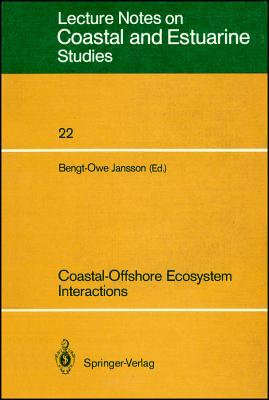
Coastal-Offshore Ecosystem Interactions: Proceedings of a Symposium Sponsored by Scor, Unesco, San Francisco Society, California Sea Grant Program, an - Paperback
$54.99
Quantity
01
Pay over time for orders over $35.00 with
Offers & Perks
Earn 54 points with this purchase
Added to your rewards balance after checkout.
100 points welcome bonus
Create an account and start with extra points.
Availability:In StockContributor:Bengt-Owe JanssonSeries:Coastal and Estuarine StudiesTheme:Topical/EcologyPublish date:3/9/1988Pages:367
Languages:EnglishPublisher:SpringerISBN-13:9783540190516ISBN-10:3540190511UPC:9783540190516Book Category:Nature, ScienceBook Subcategory:Animals, Life Sciences, Earth SciencesBook Topic:Marine Life, Ecology, OceanographySize:10.00 x 7.00 x 0.79 inchesWeight:0.663Product ID:SC1H65RXPD
stable isotope ratios act as naturally-occurring tracers for organic matter, making possible, under certain conditions, the quantification of coastal-offshore exchanges. In general, organic matter has isotope ratios characteristic of its origin (e. g. plants with different modes of photosynthesis and different growth conditions, anthropogenic compounds). These ratios are maintained as the organic matter moves through the biosphere and geosphere. A mixture of organic matter from two sources has isotope ratios intermediate between those of the two sources, in proportion to the fraction of material from each source. Isotope ratios are one of the few methods which can trace organic matter as it moves through natural ecosystems. Ratios can be measured on both the total organic matter and on particular chemical fractions or compounds. When used on organisms, isotope ratios provide information of organic matter actually assimilated into body tissues, not just material ingested. As with all tools, this method has certain limitations which must be borne in mind when interpreting its results. Firstly, specific environmental conditions must be met. This generally means an ecosystem with a limited and known number of sources of organic matter having different isotope ratios. Two sources with different isotope ratios are ideal; additional sources with other isotope ratios complicate interpretation. Secondly, the difference in isotope ratios of the two sources should be large compared with analytical variability. Thirdly, the ratios within each source should vary as little as possible.
Languages:EnglishPublisher:SpringerISBN-13:9783540190516ISBN-10:3540190511UPC:9783540190516Book Category:Nature, ScienceBook Subcategory:Animals, Life Sciences, Earth SciencesBook Topic:Marine Life, Ecology, OceanographySize:10.00 x 7.00 x 0.79 inchesWeight:0.663Product ID:SC1H65RXPD
Publisher: Springer
Contributor(s)
Free shipping on orders over $75. Standard shipping takes 3-7 business days. Eligible items may be returned within 30 days of delivery. Conditions apply.