
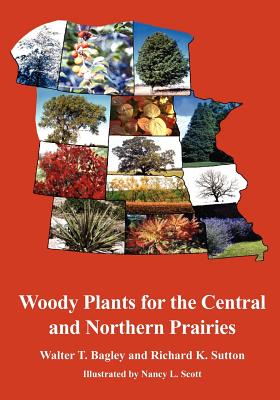
Woody Plants for the Central and Northern Prairies - Paperback
$73.99
$79.95
-7%Quantity
01
Pay over time for orders over $35.00 with
Offers & Perks
Earn 73 points with this purchase
Added to your rewards balance after checkout.
100 points welcome bonus
Create an account and start with extra points.
Availability:In StockContributor:Walter Thaine Bagley, Richard K. SuttonPublish date:8/1/2002Pages:620
Languages:EnglishPublisher:Blackburn PressISBN-13:9781930665507ISBN-10:1930665504UPC:9781930665507Book Category:Nature, ScienceBook Subcategory:Plants, Life SciencesBook Topic:Trees, Horticulture, BotanySize:10.00 x 7.00 x 1.25 inchesWeight:1.058Product ID:SCQD786NX2
Many people are frustrated by their inability to determine the identity of a woody plant growing in their backyards, neighborhood parks, along a roadside or at a vacation site. Woody Plants for the Central and Northern Prairies attempts to assist them by providing descriptions and sketches of most of the native and exotic plants that they are likely to find or wish to grow. This book includes line drawn illustrations for ease of identification. The authors decided that in promoting sustainable landscapes, they should include both native and exotic woody plants adapted to a portion of the Great Plains. Since many of the plants described are native or adapted to other regions of the temperate zone, Woody Plants for the Central and Northern Prairies will be a useful reference well beyond the confines of the central and northern prairies of North America. The book will be an excellent basic reference for interested laypersons and teachers as well as professionals. It attempts to provide factual information to professional and amateur horticulturalists, landscape designers, foresters, students, farmers and urban dwellers in the heartland of the United States. Plants in the book can be identified by simple grouping charts and without the use of tedious keys. They are presented in related phylogenetic groups (orders, families, genera, species) based on a modern theory of evolution. Species are arranged in sequence, beginning with gymnosperms (Pinophyta), the most primitive and progressing through the dicots (Magnoliopsida) and the monocots (Liliopsida) of the angiosperms (Magnoliophyta). The angiosperms are arranged in a sequence based on one of the latest theories of plant evolution (Cronquist 1981) a theory which deviates considerably from that of Rehder (1940) whose manual the authors rely on as a valuable taxonomic resource. Subclasses, orders and families are arranged in phylogenetic sequence. Within each family and subfamily, the authors have arranged genera alphabetically. Species are listed alphabetically under each genus unless easily discernible characteristics, such as evergreen vs. deciduous, permits grouping by common characteristics to aid in identification. A concise paragraph titled "Planning" is included for each species to provide information about plant size and habit, date of bloom, foliage color, site requirements, zone of adaptation and landscape use. Walter T. (Thaine) Bagley retired from the University of Nebraska after 30 years devoted to tree improvement, windbreak research and teaching forestry and horticulture classes. He and wife, Virginia, live at Prairie Pines, a small farm on which they established an environment during the past 40 years designed to improve habitat for plants and animals including mankind. Prairie Pines is also a Nebraska Statewide Arboretum site and home to over 200 woody plant species. It is now being developed as a University of Nebraska-Lincoln natural resources education center. Richard K. Sutton is an Associate Professor and a registered landscape architect; he teaches plant materials and landscape design courses at the University of Nebraska-Lincoln. He has lived in Nebraska, Colorado, Utah, Nevada, Idaho, and Wisconsin, and has traveled widely in the Great Plains including Canada observing, identifying, and using the species which make up Woody Plants for the Central and Northern Prairies. The illustrator, Nancy Scott, grew up near Bloomington, Indiana, in a home surrounded by a wooded area of native trees and plants with parents who fostered a strong interest in nature in her. She graduated from the University of Nebraska-Lincoln with a BS degree in art. Her Masters degree is in Recreation Administration from the University of Nebraska-Omaha with a parks emphasis. She has been employed as a horticulturist since 1975.
Languages:EnglishPublisher:Blackburn PressISBN-13:9781930665507ISBN-10:1930665504UPC:9781930665507Book Category:Nature, ScienceBook Subcategory:Plants, Life SciencesBook Topic:Trees, Horticulture, BotanySize:10.00 x 7.00 x 1.25 inchesWeight:1.058Product ID:SCQD786NX2
Publisher: Blackburn Press
Contributor(s)
Free shipping on orders over $75. Standard shipping takes 3-7 business days. Returns accepted within 30 days of purchase.