
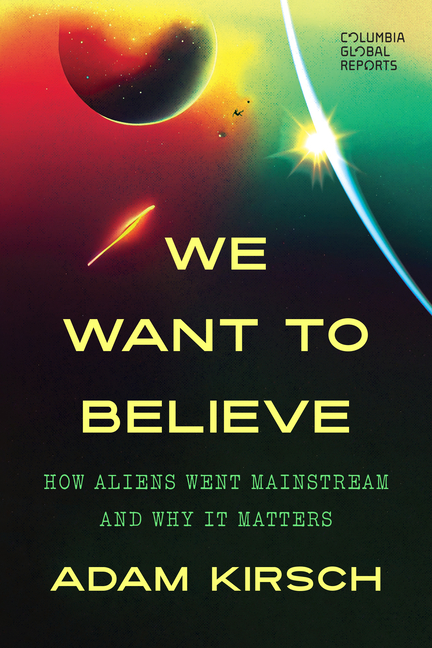
We Want to Believe: How Aliens Went Mainstream and Why It Matters - Paperback
by Adam Kirsch
$12.99
$18.00
-28%Quantity
01
Pay over time for orders over $35.00 with
Offers & Perks
Earn 12 points with this purchase
Added to your rewards balance after checkout.
100 points welcome bonus
Create an account and start with extra points.
Languages:EnglishPublisher:Columbia Global ReportsISBN-13:9781967190164ISBN-10:196719016XUPC:9781967190164Book Category:Philosophy, Science, Mind, Body, SpiritBook Subcategory:Epistemology, Philosophy & Social Aspects, Supernatural & UnexplainedBook Topic:UFOs, UAPs & ExtraterrestrialsSize:7.30 x 4.90 x 0.80 inchesWeight:0.136Product ID:SCCH92H1KD
Why do we still believe in UFOs, despite repeated efforts to dismiss them?
For most of the twentieth century, reports of unidentified flying objects were treated as cultural error: cranks, hoaxes, late-night radio. Then, abruptly, the posture changed. The Pentagon released videos it could not explain. Navy pilots testified under oath about encounters that defied known technology. Intelligence agencies acknowledged that something unfamiliar appears to move through the skies.
In We Want to Believe, Adam Kirsch, one of our most searching literary critics, traces the intellectual history behind this reversal to see UAPs not as fantasies or threats, but as a mystery closer to home. Moving from Cold War skeptics such as physicists Edward Condon and Carl Sagan--who helped define the boundaries of legitimate inquiry--to figures like Air Force officer Edward Ruppelt and astronomer J. Allen Hynek, who encountered anomalies from within official institutions, Kirsch follows how UAPs migrated from dismissed error to unresolved problem. Tracing how figures such as Pentagon official Luis Elizondo and astrophysicist Avi Loeb have reopened the question under radically different conditions, Kirsch draws on declassified documents, military encounters, and a wide literature of belief and skepticism to examine why some questions endure and what it means for modern societies when certainty fails and curiosity persists.
For most of the twentieth century, reports of unidentified flying objects were treated as cultural error: cranks, hoaxes, late-night radio. Then, abruptly, the posture changed. The Pentagon released videos it could not explain. Navy pilots testified under oath about encounters that defied known technology. Intelligence agencies acknowledged that something unfamiliar appears to move through the skies.
In We Want to Believe, Adam Kirsch, one of our most searching literary critics, traces the intellectual history behind this reversal to see UAPs not as fantasies or threats, but as a mystery closer to home. Moving from Cold War skeptics such as physicists Edward Condon and Carl Sagan--who helped define the boundaries of legitimate inquiry--to figures like Air Force officer Edward Ruppelt and astronomer J. Allen Hynek, who encountered anomalies from within official institutions, Kirsch follows how UAPs migrated from dismissed error to unresolved problem. Tracing how figures such as Pentagon official Luis Elizondo and astrophysicist Avi Loeb have reopened the question under radically different conditions, Kirsch draws on declassified documents, military encounters, and a wide literature of belief and skepticism to examine why some questions endure and what it means for modern societies when certainty fails and curiosity persists.
Languages:EnglishPublisher:Columbia Global ReportsISBN-13:9781967190164ISBN-10:196719016XUPC:9781967190164Book Category:Philosophy, Science, Mind, Body, SpiritBook Subcategory:Epistemology, Philosophy & Social Aspects, Supernatural & UnexplainedBook Topic:UFOs, UAPs & ExtraterrestrialsSize:7.30 x 4.90 x 0.80 inchesWeight:0.136Product ID:SCCH92H1KD
Kirsch, Adam: - Adam Kirsch is a poet and literary critic who has written several collections of poems and books of criticism and biography, including The Global Novel and The Revolt Against Humanity, both published by Columbia Global Reports. He lives in New York City, where he is a senior editor at The Atlantic.
Publisher: Columbia Global Reports
Contributor(s)
Author
Free shipping on orders over $75. Standard shipping takes 3-7 business days. Eligible items may be returned within 30 days of delivery. Conditions apply.