
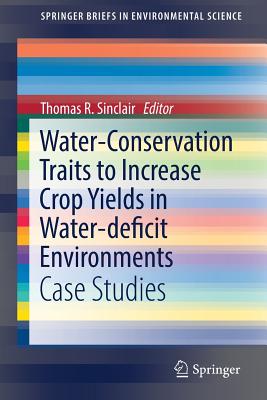
Water-Conservation Traits to Increase Crop Yields in Water-Deficit Environments: Case Studies - Paperback
$54.99
Quantity
01
Pay over time for orders over $35.00 with
Offers & Perks
Earn 54 points with this purchase
Added to your rewards balance after checkout.
100 points welcome bonus
Create an account and start with extra points.
Availability:In StockContributor:Thomas R. SinclairSeries:Springerbriefs in Environmental ScienceTheme:Topical/EcologyPublish date:5/22/2017Pages:95
Languages:EnglishPublisher:SpringerISBN-13:9783319563206ISBN-10:3319563203UPC:9783319563206Book Category:Nature, ScienceBook Subcategory:Environmental Conservation & Protection, Earth Sciences, Life SciencesBook Topic:Hydrology, BotanySize:9.21 x 6.14 x 0.22 inchesWeight:0.163Product ID:SC84CFPXDF
This volume explores specific approaches that have shown to result in crop yield increases. Research on the physiological understanding of these methods has led to the development of practical applications of plant breeding approaches to genetically improve crops to achieve higher yields. Authoritative entries from crop scientists shed new light on two water-conservation traits: one that is based on an initiation of the decrease in transpiration earlier in the soil drying cycle, and the second that is based on a sensitivity of transpiration rate under high atmospheric vapor pressure deficit that results in partial stomatal closure. Both these approaches involve partial stomatal closure under well-defined situations to decrease the rate of soil water loss.
Readers will be able to analyze the circumstances under which a benefit is achieved as a result of the water-limitation trait; and key discussion points in the case studies presented willhelp answer questions such as what species, which environments, how often will yield be benefited for various crop species? Contributions also review the genetic variation for these two traits within each crop species and the physiological basis for the expression of these traits.
Readers will be able to analyze the circumstances under which a benefit is achieved as a result of the water-limitation trait; and key discussion points in the case studies presented willhelp answer questions such as what species, which environments, how often will yield be benefited for various crop species? Contributions also review the genetic variation for these two traits within each crop species and the physiological basis for the expression of these traits.
Languages:EnglishPublisher:SpringerISBN-13:9783319563206ISBN-10:3319563203UPC:9783319563206Book Category:Nature, ScienceBook Subcategory:Environmental Conservation & Protection, Earth Sciences, Life SciencesBook Topic:Hydrology, BotanySize:9.21 x 6.14 x 0.22 inchesWeight:0.163Product ID:SC84CFPXDF
Dr. Thomas R. Sinclair is an adjunct professor in crop science at North Carolina State University. His research focuses on the interactions between plant physiology and the environment to determine crop yields. He is currently investigating plant traits that may increase drought tolerance.
Publisher: Springer
Edition
2017 Edition
Contributor(s)
Free shipping on orders over $75. Standard shipping takes 3-7 business days. Eligible items may be returned within 30 days of delivery. Conditions apply.