
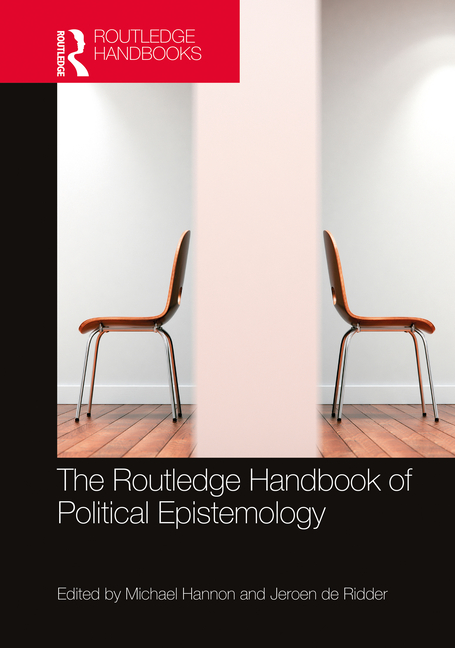
The Routledge Handbook of Political Epistemology - Hardcover
Choose Option
Hardcover

The Routledge Handbook of Political Epistemology
Pay over time for orders over $35.00 with
Offers & Perks
Earn 346 points with this purchase
Added to your rewards balance after checkout.
100 points welcome bonus
Create an account and start with extra points.
As political discourse had been saturated with the ideas of "post-truth", "fake news", "epistemic bubbles", and "truth decay", it was no surprise that in 2017 The New Scientist declared: "Philosophers of knowledge, your time has come." Political epistemology has old roots, but is now one of the most rapidly growing and important areas of philosophy.
The Routledge Handbook of Political Epistemology is an outstanding reference source to this exciting field, and the first collection of its kind. Comprising 41 chapters by an international team of contributors, it is divided into seven parts:
- Politics and truth: historical and contemporary perspectives
- Political disagreement and polarization
- Fake news, propaganda, and misinformation
- Ignorance and irrationality in politics
- Epistemic virtues and vices in politics
- Democracy and epistemology
- Trust, expertise, and doubt.
Within these sections crucial issues and debates are examined, including: post-truth, disagreement and relativism, epistemic networks, fake news, echo chambers, propaganda, ignorance, irrationality, political polarization, virtues and vices in public debate, epistocracy, expertise, misinformation, trust, and digital democracy, as well as the views of Plato, Aristotle, Mòzǐ, medieval Islamic philosophers, Mill, Arendt, and Rawls on truth and politics.
The Routledge Handbook of Political Epistemology is essential reading for those studying political philosophy, applied and social epistemology, and politics. It is also a valuable resource for those in related disciplines such as international relations, law, political psychology, political science, communication studies, and journalism.
Michael Hannon is Assistant Professor of Philosophy at the University of Nottingham, UK. He is author of What's the Point of Knowledge? (2019), and is writing the forthcoming Routledge book Political Epistemology: An Introduction.
Jeroen de Ridder is Associate Professor of Philosophy at Vrije Universiteit Amsterdam, and Professor (by special appointment) of Christian Philosophy at the University of Groningen, The Netherlands.
Contributor(s)
Free shipping on orders over $75. Standard shipping takes 3-7 business days. Returns accepted within 30 days of purchase.