
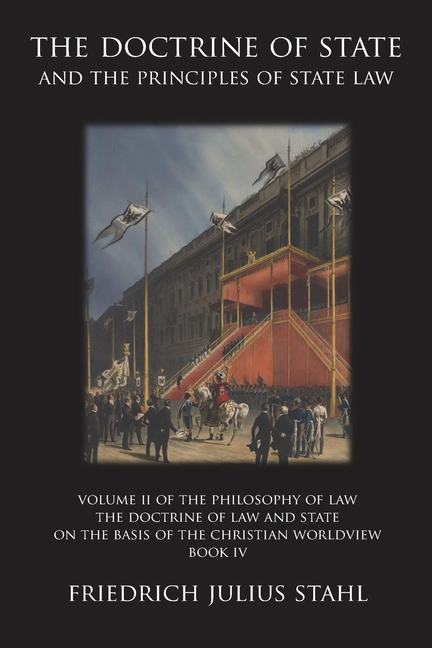
The Doctrine of State and the Principles of State Law - Paperback
Pay over time for orders over $35.00 with
Offers & Perks
Earn 22 points with this purchase
Added to your rewards balance after checkout.
100 points welcome bonus
Create an account and start with extra points.
Suppose that Wilhelm I had never become King of Prussia, and instead his brother, Friedrich Wilhelm IV, who was only 11/2 years his senior and had reigned since 1840, had been given the same number of years to live as he had. For Wilhelm died in 1888. In that case, the kind of kingship which is outlined in this book would, in general if not in every detail, continue to have been implemented in Prussia. Events would most likely have continued to proceed along the lines they did in the 1850s. Military expansion would not have been pursued in the teeth of opposition from the estates; Otto von Bismarck would not have been installed as Chancellor; Prussia would have maintained the peace-seeking approach of its foreign policy as was exemplified in its neutral stance during the Crimean War; Germany would not have been unified over the backs of Austria and France and by military annexation of the autonomous German territories; the seeds would not have been sown for two world wars and a great depression.
How differently would history have turned out! There would have been the example of a Christian monarchy pursuing the glory of God and not Realpolitik; there would have been the rule of law based on the Word of God rather than the word of man; there would have been maintained a system of representation which sustained the monarchy rather than the monied interest. Above all, a halt would have been called to the progression of unbelief and revolution.
But it was not to be. Friedrich Wilhelm IV, suffering from a series of strokes beginning in 1857, died in 1861. The author of this book, Friedrich Julius Stahl, died in the same year. With them went the only hope for a peaceful Germany and a de-revolutionized Europe.
In 1867, the Dutch statesman Guillaume Groen van Prinsterer asked the rhetorical question: "If King Frederick William IV were still alive, would M. von Bismarck have had the chance to carry out his vast designs?" (L'Empire Prussien et l'Apocalypse, p. 56). His answer, based on extensive citations from Stahl's writings, was a resounding "No."
Modern historiography knows nothing of this. All it knows is that Friedrich Wilhelm IV lived in a romanticized past and refused to recognize the progress taking place all around him. He was the reactionary monarch who stifled Prussia's advance into liberal modernity. But we need to ask the question: to what exactly did that progress actually lead? Perhaps the King of Prussia - and Stahl with him - knew something that modern historians do not.
This second edition of The Doctrine of State and the Principles of State Law has been thoroughly reworked while also being supplemented with newly translated material.
Edition
2nd Edition
Contributor(s)
Author
Free shipping on orders over $75. Standard shipping takes 3-7 business days. Eligible items may be returned within 30 days of delivery. Conditions apply.