
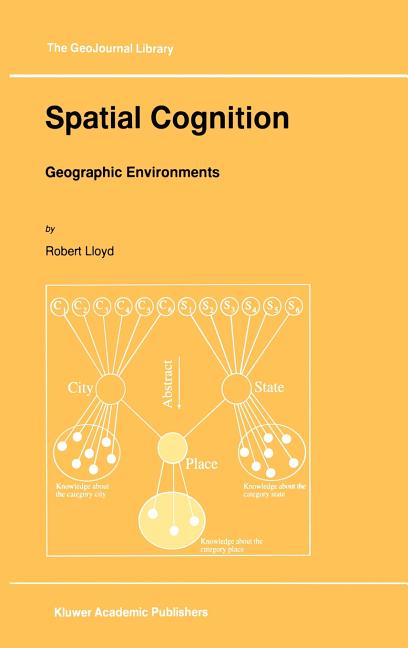
Spatial Cognition: Geographic Environments - Hardcover
by R. Lloyd
$168.99
$169.99
-1%Quantity
01
Pay over time for orders over $35.00 with
Offers & Perks
Earn 168 points with this purchase
Added to your rewards balance after checkout.
100 points welcome bonus
Create an account and start with extra points.
Languages:EnglishPublisher:SpringerISBN-13:9780792343752ISBN-10:0792343751UPC:9780792343752Book Category:Travel, Science, ComputersBook Subcategory:Earth Sciences, Artificial IntelligenceBook Topic:GeographySize:9.21 x 6.14 x 0.75 inchesWeight:0.617Product ID:SC1HEP6BDY
10.2 Summary of Ideas ..................................................... 256 10.2.1 Spatial Behavior As Rules For Decision Making ................................... 258 10.2.2. Cognitive Mapping ......................................................................... 258 10.2.3. Storing Information ................................................. " ...................... 260 10.2.4. Searching ..................................................................................... 260 10.2.5. Learning ........................................................................................ 261 10.2.6. Judging Similarity .......................................................................... 261 10.2.7 Neural Geographic Information Science (NGIS) .................................... 262 REFERENCES ............................................... 265 INDEX ........................ .............. 279 ACKNOWLEDGEMENTS ................................... 287 x LIST OF TABLES Table 8.1: The types of similarity comparisons created for the experiment to determine the effect ofx as a first or second common or distinctive feature (Lloyd, Rostkowska-Covington, and Steinke 1996). Table 9.1: Data used to compute the gravity model using regression and a neural network. Data for all variables are scaled so that the highest value equals 0.9 and the lowest value equals 0.1. Table 9.2: Class means for 11 socio-economic and life-cycle variables for the Black, Integrated, and White classes. Table 9.3: Weights for neuron at row 5 and column 1 that learned the blue horizontal rectangle map symbol. LIST OF FIGURES Figure 1.1: Spatial cognition is a research area of interest for both geography and psychology. Both disciplines are interested in fundamental ideas related to encoding processes, internal representations, and decoding processes. Figure 1.2: The place names on this map of New Orleans depict the propositions used for navigation by local residents. A similar map appeared in theJune 30, 1991, edition of The Times-Picayune.
Languages:EnglishPublisher:SpringerISBN-13:9780792343752ISBN-10:0792343751UPC:9780792343752Book Category:Travel, Science, ComputersBook Subcategory:Earth Sciences, Artificial IntelligenceBook Topic:GeographySize:9.21 x 6.14 x 0.75 inchesWeight:0.617Product ID:SC1HEP6BDY
Free shipping on orders over $75. Standard shipping takes 3-7 business days. Eligible items may be returned within 30 days of delivery. Conditions apply.