
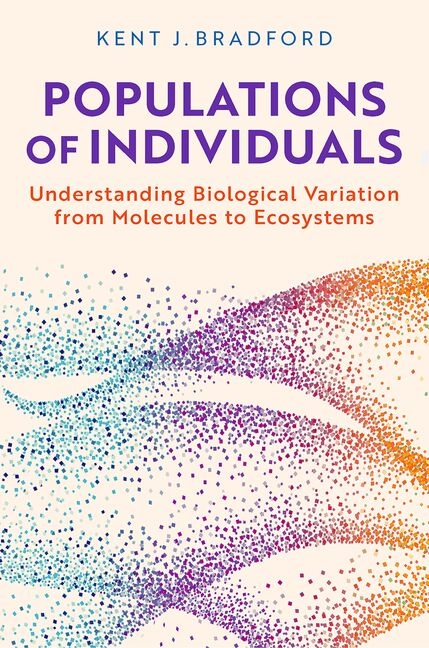
Populations of Individuals: Understanding Biological Variation from Molecules to Ecosystems - Hardcover
$133.99
Quantity
01
Pay over time for orders over $35.00 with
Offers & Perks
Earn 133 points with this purchase
Added to your rewards balance after checkout.
100 points welcome bonus
Create an account and start with extra points.
Languages:EnglishPublisher:Oxford University PressISBN-13:9780197846001ISBN-10:0197846009UPC:9780197846001Book Category:ScienceBook Subcategory:Life SciencesBook Topic:Biology, Genetics & GenomicsSize:9.33 x 6.50 x 0.76 inchesWeight:0.617Product ID:SC5WNBKPX3
Variation is an inherent component of biology, essential to selection among alternatives during evolution. It is most often associated with genetic variation, or differences among the genes encoded in the DNA inherited from ancestors. Individual organisms receive their genomes from a clonal parent or from the union of gametes. All subsequent cells, tissues, and organs developed from a clone or sexual union carry the same genome, but they exhibit the ability to develop into the diversity of cell types present in the organism. Such variation is influenced by both developmental and environmental factors, often referred to as being due to 'instability' or 'noise.' This book argues that the degree to which individual organisms adapt to this 'noise' is dependent on their sensitivities to these developmental or environmental factors. Focusing on their sensitivity thresholds enables the individuals to be grouped into populations that automatically respond to signal inputs. These sensitivity thresholds tend to vary among individuals in a normal distribution, such that as the factor level increases, more of the individuals are recruited to respond as their thresholds are exceeded. In addition, the amount by which the factor level increases above the threshold determines the speed of the response. The author, Kent Bradford, terms this method of grouping populations the 'population-based threshold' (PBT) model. Populations of Individuals illustrates with examples from each level of biological complexity that this underlying principle can replace instability and noise with a coherent and mathematically consistent description of stable variation observed across the breadth of biology. This viewpoint and model are particularly relevant today, when methods for investigating individual molecules, nuclei, organelles, and cells are available. The PBT model indicates that viewing such variation as being due to multiple subpopulations based on their threshold sensitivities is both simpler and more consistent with the available data.
Languages:EnglishPublisher:Oxford University PressISBN-13:9780197846001ISBN-10:0197846009UPC:9780197846001Book Category:ScienceBook Subcategory:Life SciencesBook Topic:Biology, Genetics & GenomicsSize:9.33 x 6.50 x 0.76 inchesWeight:0.617Product ID:SC5WNBKPX3
Kent J. Bradford is a Distinguished Professor Emeritus in the Department of Plant Sciences at the University of California, Davis. He received his BS in Biochemistry and his MS in Horticulture at Michigan State University and his PhD in Plant Physiology from the University of California, Davis. After a postdoctoral fellowship at the Australian National University, he joined the faculty at UC Davis in 1982 and served as the Chair of the Department of Vegetable Crops from 1993 to 1998. He founded the UC Davis Seed Biotechnology Center in 1999 and served as its director until his retirement in 2019.
Publisher: Oxford University Press
Contributor(s)
Author
Free shipping on orders over $75. Standard shipping takes 3-7 business days. Returns accepted within 30 days of purchase.