
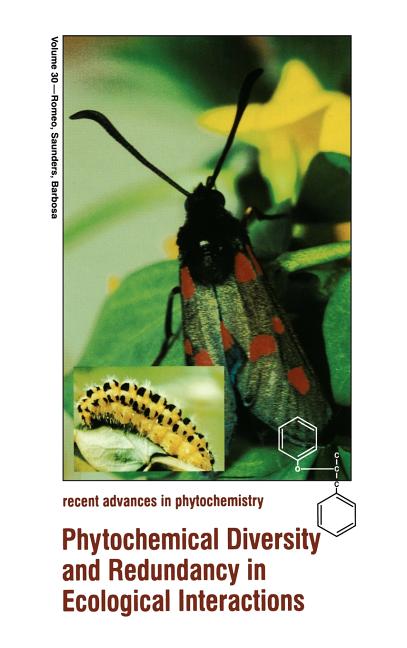
Phytochemical Diversity and Redundancy in Ecological Interactions - Hardcover
$168.99
$169.99
-1%Quantity
01
Pay over time for orders over $35.00 with
Offers & Perks
Earn 168 points with this purchase
Added to your rewards balance after checkout.
100 points welcome bonus
Create an account and start with extra points.
Availability:In StockContributor:John T. Romeo, James A. Saunders, Pedro BarbosaSeries:Recent Advances in PhytochemistryPublish date:11/30/1996Pages:319
Languages:EnglishPublisher:SpringerISBN-13:9780306455001ISBN-10:0306455005UPC:9780306455001Book Category:ScienceBook Subcategory:Life SciencesBook Topic:Anatomy & Physiology, Biochemistry, BotanySize:9.00 x 6.00 x 0.88 inchesWeight:0.658Product ID:SCBWPQ2CK2
Diversity within and among living organisms is both a biological impera- tive and a biological conundrum. Phenotypic and genotypic diversity is the critical currency ofecological interactions and the evolution of life. Thus, it is not unexpected to find vast phytochemical diversity among plants. However, among the most compelling questions which arise among those interested in ecological phytochemistry is the extent, nature, and reasons for the diversity of chemieals in plants. The idea that natural products (secondary metabolites) are accidents of metabolism and have no biological function is an old one which has resurfaced recently under a new term "redundancy. " Redundancy in the broader sense can be viewed as duplication of effort. The co-occurrence of several classes of phytochemieals in a given plant may be redundancy. Is there unnecessary duplication of chemical defense systems and ifso, why? What selective forces have produced this result? On the other hand, why does the same compound often have multiple functions? At a symposium of the Phytochemical Society of North America held in August 1995, in Sault Ste. Marie, Ontario, Canada, the topic "Phytochernical Redundancy in Ecological Interactions" was discussed. The chapters in this volume are based on that symposium. They both stimulate thought and provide some working hypotheses for future research. It is being increasingly recognized that functional diversity and multiplicity of function of natural products is the norm rather than the exception.
Languages:EnglishPublisher:SpringerISBN-13:9780306455001ISBN-10:0306455005UPC:9780306455001Book Category:ScienceBook Subcategory:Life SciencesBook Topic:Anatomy & Physiology, Biochemistry, BotanySize:9.00 x 6.00 x 0.88 inchesWeight:0.658Product ID:SCBWPQ2CK2
Publisher: Springer
Edition
1996 Edition
Contributor(s)
Free shipping on orders over $75. Standard shipping takes 3-7 business days. Returns accepted within 30 days of purchase.