
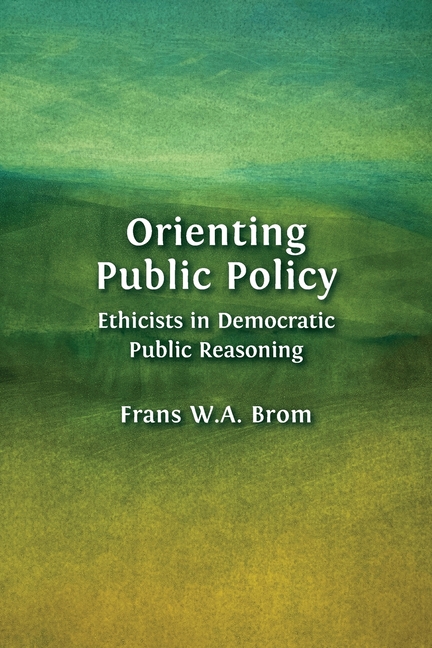
Orienting Public Policy: Ethicists in Democratic Public Reasoning - Paperback
$33.99
$35.95
-5%Quantity
01
Pay over time for orders over $35.00 with
Offers & Perks
Earn 33 points with this purchase
Added to your rewards balance after checkout.
100 points welcome bonus
Create an account and start with extra points.
Languages:EnglishPublisher:Open Book PublishersISBN-13:9781805119517ISBN-10:1805119516UPC:9781805119517Book Category:Political Science, PhilosophyBook Subcategory:History & Theory, Political, AsianSize:9.21 x 6.14 x 0.61 inchesWeight:0.427Product ID:SCWY80RJSF
Moral philosophers and academic ethicists contribute to society in several ways: as members of advisory committees, authors of policy reports, and public intellectuals engaged in policy debates. They do so not merely as citizens, but in their professional capacity as academics participating in democratic public reasoning. But on what grounds? This book develops a philosophical framework to clarify the nature of that role.In pluralist democracies, deep moral disagreement is not a problem to be eliminated but a condition to be navigated. Rather than aiming for consensus or imposing definitive moral conclusions, the book argues that ethicists can best contribute by strengthening the conditions under which disagreement becomes productive, reflective, and mutually intelligible, thereby supporting democratic legitimacy.Drawing on moral and political philosophy, the book presents ethics as a reflective practice and understands professional engagement as a form of ethics advice. While often addressing concrete issues, such advice ultimately serves to cultivate the democratic ethos necessary for open societies under pluralism. The framework highlights three core activities-explicating, engaging, and orienting-through which ethicists can support democratic deliberation. Case studies on climate justice, animal experimentation, and food policy illustrate how ethical analysis can clarify normative assumptions, foster dialogue across differences, and help navigate contested issues without erasing pluralism.In an era of increasing polarization, the book calls for a renewed understanding of ethics as a reflective public practice. It offers guidance for philosophers, policymakers, and advisors seeking to sustain a democratic ethos grounded in equality, dignity, and the rule of law.
Languages:EnglishPublisher:Open Book PublishersISBN-13:9781805119517ISBN-10:1805119516UPC:9781805119517Book Category:Political Science, PhilosophyBook Subcategory:History & Theory, Political, AsianSize:9.21 x 6.14 x 0.61 inchesWeight:0.427Product ID:SCWY80RJSF
Brom, Frans W. A.: - Frans W.A. Brom is secretary-director of the Netherlands Scientific Council for Government Policy (WRR), an independent advisory body to the Dutch government. The WRR's mandate is to provide science-based strategic advice on issues with significant political and societal impact, directed at government, parliament, and the broader public. The WRR is an independent part of the Prime-Ministers Office. In conjunction with the WRR, he holds a professorship in Normativity of Scientific Policy Advice at the Ethics Institute of Utrecht University.Before he was appointed at the WRR Frans was head of Technology Assessment at the Rathenau Institute. (2007 to 2015) The Rathenau Institute supports the formation of public and political opinion on socially relevant aspects of science and technology. It conducts research on this subject and organises debates on science, innovation, and new technology and advices parliament. He combined the function with a professorship at the Ethics Institute of Utrecht University in Ethics of Technology Assessment (2010-2025). He worked before as professor of Ethics of Life Sciences at Wageningen University (2004-2009). Between 1991 and 2007, he worked as a lecturer and researcher in ethics mainly at Utrecht University. Frans has combined his academic work with service on several advisory committees. Among other roles, he has been a member of the Board of the Committee on Genetic Modification (COGEM), a member of the working group on xenotransplantation of the Netherlands Health Council, Chair of the Scientific Integrity Committee of Wageningen University, a member of the Netherlands Animal Council, and Chair of the Central Research Ethics Advisory Group of Unilever International. He also served as Chair of the Dutch Society for Bioethics (NVBe), founding secretary of the European Society for Agricultural and Food Ethics (EurSAFE), and board member of Societas Ethica.Frans studied ethics at the Catholic Theological University in Amsterdam, with an extended minor in philosophy of law at Free University Amsterdam. He obtained his doctorate in ethics in 1997 at Utrecht University with a thesis on animal biotechnology as a moral problem. For his thesis he worked as co-secretary of the Temporary Committee for the ethical assessment of transgenic animals that advised the Netherlands Department of Agriculture (see: Brom, F.W.A., J.M.G. Vorstenbosch & E. Schroten, 'Public policy and transgenic animals; case-by-case assessment as a moral learning process', P. Wheale, et al. (eds), The social managment of genetic engineering. Aldershot: Asgate 1998: 249-264).
Publisher: Open Book Publishers
Contributor(s)
Author
Free shipping on orders over $75. Standard shipping takes 3-7 business days. Eligible items may be returned within 30 days of delivery. Conditions apply.