
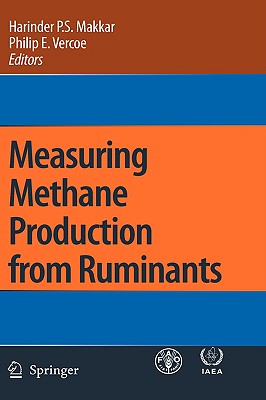
Measuring Methane Production from Ruminants - Hardcover
$108.99
$109.99
-1%Quantity
01
Pay over time for orders over $35.00 with
Offers & Perks
Earn 108 points with this purchase
Added to your rewards balance after checkout.
100 points welcome bonus
Create an account and start with extra points.
Availability:In StockContributor:Harinder P. S. Makkar, Philip E. VercoePublish date:9/27/2007Pages:138
Languages:EnglishPublisher:SpringerISBN-13:9781402061325ISBN-10:1402061323UPC:9781402061325Book Category:Science, Technology & EngineeringBook Subcategory:Environmental Science, Environmental, Life SciencesBook Topic:Pollution Control, Anatomy & PhysiologySize:9.21 x 6.14 x 0.38 inchesWeight:0.39Product ID:SC050NYMXD
The world's livestock sector is amidst a major transformation, fuelled by high demand for meat and milk, which is likely to double over the next two decades in developing countries. The major driving force behind this demand for livestock products is a combination of population growth, urbanization and income growth, especially in developing countries. The challenge is to enhance animal productivity without adversely affecting the environment. A key to this is reducing methane emissions from ruminants. The major limitation to ruminant production in many tropical regions of Africa, Asia and Latin America, where a large proportion of the global ruminant population is located, is poor nutrition. The productivity of animals is restricted by the low nitrogen and high fibre content of the native grasses and crop residues, which form the basis of the diets in these regions. Animals on these types of diets emit more methane than animals fed better quality temperate forages. These methane emissions represent a loss of digestible energy to the animal (up to 15%) as well as a threat to the environment. Reducing methane production by ruminants could improve their productivity, provided the efficiency of ruminal metabolism is not compromised, and reduce their contribution to greenhouse gas emissions. The challenge is to devise nutritional strategies and identify dietary components, particularly from locally available plant resources, that reduce methane emissions.
Languages:EnglishPublisher:SpringerISBN-13:9781402061325ISBN-10:1402061323UPC:9781402061325Book Category:Science, Technology & EngineeringBook Subcategory:Environmental Science, Environmental, Life SciencesBook Topic:Pollution Control, Anatomy & PhysiologySize:9.21 x 6.14 x 0.38 inchesWeight:0.39Product ID:SC050NYMXD
Publisher: Springer
Edition
2007 Edition
Contributor(s)
Free shipping on orders over $75. Standard shipping takes 3-7 business days. Eligible items may be returned within 30 days of delivery. Conditions apply.