
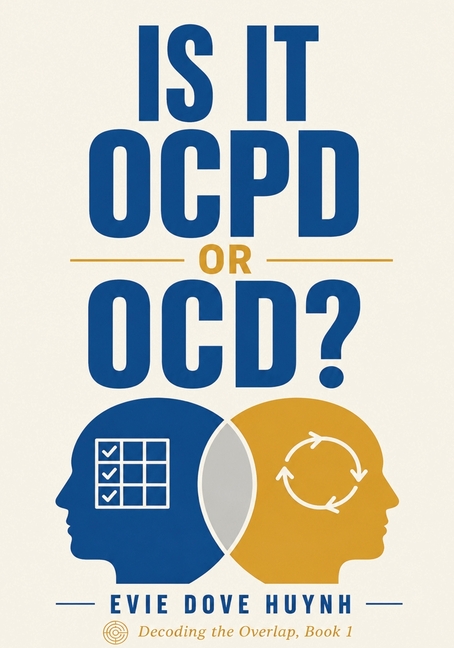
Is It OCPD or OCD?: Telling apart the disorder of doubt and the disorder of control, and why the difference changes the treatment - Paperback
Pay over time for orders over $35.00 with
Offers & Perks
Earn 13 points with this purchase
Added to your rewards balance after checkout.
100 points welcome bonus
Create an account and start with extra points.
Two names that are easy to confuse. Two patterns that need different questions.
OCD and obsessive-compulsive personality disorder can both involve checking, perfectionism, rules, exactness, overpreparing, and difficulty letting go. From the outside, the behavior may look almost identical. If an OCD diagnosis has never quite described your experience, or if the word "perfectionism" explains too little, the useful question is not simply what you do. It is what starts the pattern, how you relate to it, what the behavior is trying to accomplish, how broadly it appears across your life, and what treatment is meant to change.
Look underneath the behavior
Is It OCPD or OCD? is a plain-language differential guide for adults trying to understand the overlap between obsessive-compulsive disorder and obsessive-compulsive personality disorder. It explains obsessions and compulsions, rigidity and control, ego-dystonic and ego-syntonic experiences, insight, perfectionism, reassurance, work patterns, relationship patterns, comorbidity, and the role of exposure and response prevention without turning any single feature into a self-diagnostic test.
Use the Five-Lens Difference Map
The book's Five-Lens Difference Map organizes observation around Trigger, Stance, Function, Reach, and Treatment Fit. Side-by-side cases show why the same behavior can serve different purposes. Comparison tables, clinician-ready worksheets, conversation scripts, a thirty-day observation journal, and a visit pack help you turn "this diagnosis does not fit" into specific examples and questions a qualified clinician can examine.
This book is for readers who have been told they have OCD but do not recognize themselves in standard descriptions; adults who identify more with perfectionism, rigidity, standards, or control; people wondering whether OCD and OCPD can occur together; partners who want language for describing patterns without diagnosing someone else; and readers preparing to ask for a diagnostic review or second opinion.
Clarity before certainty
A book cannot determine whether you have OCD, OCPD, both, or another explanation. What it can do is help you describe the pattern with more precision. If you want a structured guide to the question that comes before treatment, this book gives you a practical way to prepare for a better clinical conversation.
Free shipping on orders over $75. Standard shipping takes 3-7 business days. Eligible items may be returned within 30 days of delivery. Conditions apply.