
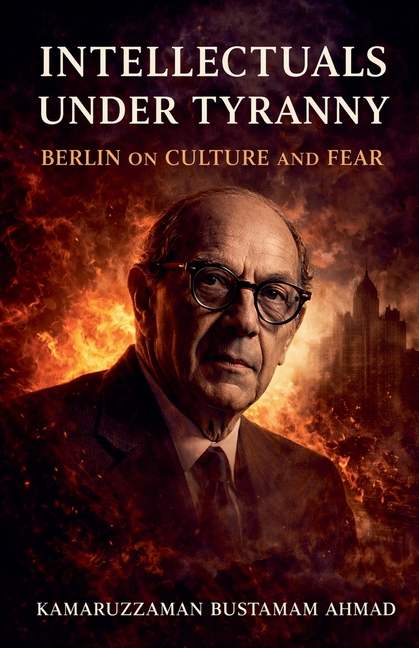
Intellectuals Under Tyranny: Isaiah Berlin on Culture and Fear - Paperback
Pay over time for orders over $35.00 with
Offers & Perks
Earn 18 points with this purchase
Added to your rewards balance after checkout.
100 points welcome bonus
Create an account and start with extra points.
Intellectuals under Tyranny: Berlin on Culture and Fear is a penetrating exploration of how intellectual life survives-and is transformed-under conditions of political domination. Drawing on Isaiah Berlin's writings on Russia, Stalinism, and twentieth-century totalitarianism, this book examines the fragile space where culture, fear, and moral judgment intersect.
Rather than treating tyranny solely as a political system, this book follows Berlin in understanding it as a cultural and moral condition. Tyranny reshapes language, disciplines imagination, and reorganises intellectual life from within. Writers, artists, philosophers, and scholars do not simply oppose or submit to power; they inhabit a world structured by fear, compromise, silence, and moral loss.
Berlin's encounters with Russian intellectuals such as Anna Akhmatova and Boris Pasternak reveal a dimension of tyranny often overlooked: its impact on how people think, hesitate, and judge. Through these encounters, Berlin developed a distinctive approach to intellectual history-one that refuses heroic myth, rejects ideological certainty, and insists on moral complexity. This book reconstructs that approach and places it at the centre of contemporary debates about freedom, ideology, and political fear.
At the heart of the book lies Berlin's critique of monism and historical necessity. Ideologies that claim final answers promise liberation but often produce coercion. By contrast, Berlin's value pluralism recognises that human values conflict and that political solutions have moral limits. This recognition does not weaken resistance to tyranny; it deepens it by restoring judgment, restraint, and responsibility.
Intellectuals under Tyranny is not a biography of Isaiah Berlin, nor a general history of Russia. It is a focused study of Berlin's interpretation of culture under oppression and his warning against the moral costs of certainty. By examining themes such as censorship, fear, ideological conformity, silence, decency, and survival, the book shows why Berlin remains essential for understanding intellectual life under authoritarian pressure-past and present.
Written in a clear yet reflective style, this book will appeal to readers interested in political philosophy, intellectual history, Russian studies, totalitarianism, and the ethics of freedom. It speaks to scholars, students, and thoughtful readers who seek to understand not only how tyranny rules, but how it inhabits the inner world of those who live and think within it.
In an age marked by ideological polarization, renewed authoritarianism, and moral absolutism, Berlin's insights offer no consolation-but they provide orientation. This book invites readers to confront the uncomfortable truth that freedom depends not on certainty, but on the preservation of human complexity.
Prof. Kamaruzzaman Bustamam Ahmad, Ph.D. is an Indonesian scholar, philosopher, and author whose works explore the intersections of religion, culture, and the moral imagination of modernity. He serves as the Dean of the Faculty of Sharia and Law at UIN Ar-Raniry, Banda Aceh, and is the founder of KBA13 Insight, a digital think tank and publishing platform dedicated to critical and interdisciplinary analysis of philosophy, geopolitics, religion, and society.
Through his writings, Prof. Ahmad bridges classical Islamic thought and global intellectual traditions, inviting readers to reflect on spirituality, ethics, and the future of humanity in an age of transformation.
Contributor(s)
Free shipping on orders over $75. Standard shipping takes 3-7 business days. Returns accepted within 30 days of purchase.