
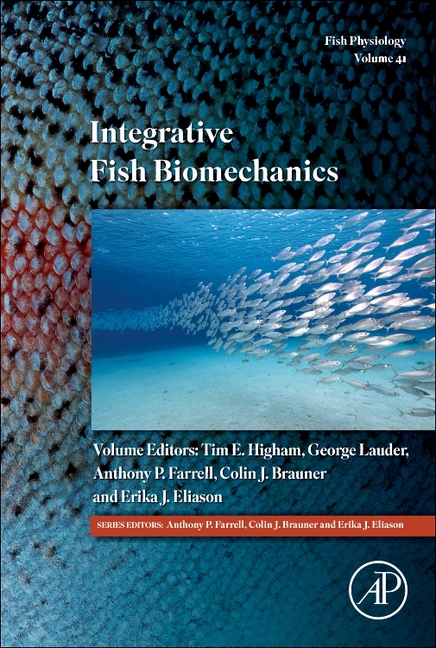
Integrative Fish Biomechanics: Volume 41 - Hardcover
Pay over time for orders over $35.00 with
Offers & Perks
Earn 131 points with this purchase
Added to your rewards balance after checkout.
100 points welcome bonus
Create an account and start with extra points.
Integrative Fish Biomechanics, Volume 41, the latest release in the Fish Physiology series, highlights new advances in the field, with this volume presenting insightful chapters written by leading experts. Covering a wide range of topics, this edition explores the intricate hydrodynamics and biomechanics of fish feeding, swimming, and terrestrial locomotion. It delves into the structural and functional properties of fish tissues, providing a deeper understanding of their mechanical adaptations.
Other chapters examine the sensing and control of fish behaviour, the role of biomechanics in fish adhesion, and the emerging field of fish robotics. The volume also discusses the ecomechanics of fish locomotion and feeding, collective behaviours, and the micro- and macroevolutionary perspectives of fish biomechanics. Offering a comprehensive look at the intersection of biology, physics, and engineering, this book provides valuable insights for researchers, marine biologists, and those interested in fish physiology and biomechanics.Dr. Timothy Edward Higham is a Full Professor in the Department of Evolution, Ecology, and Organismal Biology at the University of California, Riverside. His research focuses on biomechanics, functional morphology, and ecology, with a particular emphasis on animal locomotion, predator-prey interactions, and adhesion in geckos.
Dr. Higham earned his B.Sc. in Zoology from the University of Calgary in 2000, followed by an M.S. in Biology from the University of Cincinnati in 2003. He completed his Ph.D. in Evolutionary Biology at the University of California, Davis, in 2006 under the mentorship of Peter C. Wainwright. He then conducted postdoctoral research at Harvard University from 2006 to 2008, working with Andrew Biewener on muscle function and biomechanics.
He began his faculty career as an Assistant Professor at Clemson University in 2008 before joining UC Riverside in 2011. He was promoted to Associate Professor in 2015 and Full Professor in 2021. In addition, he was awarded an Alexander von Humboldt Fellowship and conducted research at the University of Freiburg and the Museum Koenig in Germany from 2017 to 2018.
Dr. Higham has published over 120 peer-reviewed articles in top scientific journals, including Current Biology, Journal of Experimental Biology, Functional Ecology, and Evolutionary Biology. His work has gained significant media attention, with coverage in Scientific American, BBC News, National Geographic, New York Times, and many other outlets.
He has been awarded several NSF grants, including funding for research on gecko adhesion, the evolution of biomechanics, and predator-prey interactions. His leadership extends beyond research, having organized multiple symposia at international conferences and serving as an editor for Scientific Reports and Physiological and Biochemical Zoology.
Dr. Higham has extensive field experience, conducting research in Bamfield Marine Sciences Centre (Canada), Namibia, French Guiana, Trinidad & Tobago, the Mojave Desert, and South Africa. His commitment to student mentorship is evident through his supervision of numerous Ph.D. and M.S. students, many of whom have secured academic positions.
In addition to his academic work, Dr. Higham actively participates in STEM outreach programs, mentoring middle and high school students through design challenges and educational events. He is a member of several professional societies, including the Society for Integrative and Comparative Biology, the British Ecological Society, and the Canadian Society of Zoologists.
With a distinguished career spanning research, teaching, and mentorship, Dr. Higham continues to make significant contributions to the fields of biomechanics and functional morphology, advancing our understanding of animal movement and evolution.
Lauder, George: -Dr. George V. Lauder is a leading American biologist specializing in biomechanics, functional morphology, and biorobotics. He currently holds the position of Henry Bryant Bigelow Professor of Ichthyology at Harvard University and serves as the Curator of Ichthyology at the Museum of Comparative Zoology. Additionally, he is a Professor in the Department of Organismic and Evolutionary Biology.
Dr. Lauder's research focuses on the biomechanics of fishes and the development of robotic models to study aquatic locomotion. His work has significantly advanced the understanding of fish locomotion, particularly through the use of digital particle image velocimetry (DPIV) techniques. This approach has provided new insights into the hydrodynamics of fish swimming and has informed the design of bio-inspired robotic systems.
After completing his undergraduate (A.B., 1976), master's (M.A., 1978), and doctoral (Ph.D., 1979) degrees in biology at Harvard University, Dr. Lauder served as a Junior Fellow at Harvard's Society of Fellows from 1979 to 1981. He then joined the University of Chicago as a faculty member, followed by a tenure at the University of California, Irvine, where he was a Professor of Ecology and Evolutionary Biology and Associate Dean of Graduate Studies. In 1999, he returned to Harvard University, where he has continued his influential research and teaching.
Dr. Lauder's contributions to science have been recognized by his election as a Fellow of the American Association for the Advancement of Science and the American Physical Society. He has also served on the editorial boards of several scientific journals, including Physiological and Biochemical Zoology, Journal of Morphology, and Soft Robotics.
Brauner, Colin: - Dr. Colin Brauner was educated in Canada at the University of British Columbia (Ph D), followed by a Post-doctoral fellowship at Aarhus University and the University of Southern Denmark, and was a Research Associate at McMaster University. He is a Professor of Zoology, UBC and Director of the UBC Aquatics Facility. He has been a Co-Editor of the Fish Physiology series since 2006. His research investigates environmental adaptations (both mechanistic and evolutionary) in relation to gas-exchange, acid-base balance and ion regulation in fish, integrating responses from the molecular, cellular and organismal level. The ultimate goal is to understand how evolutionary pressures have shaped physiological systems among vertebrates and to determine the degree to which physiological systems can adapt/acclimate to natural and anthropogenic environmental changes. This information is crucial for basic biology and understanding the diversity of biological systems, but much of his research conducted to date can also be applied to issues of aquaculture, toxicology and water quality criteria development, as well as fisheries management. His achievements have been recognized by the Society for Experimental Biology, UK (President's medal) and the Canadian Conference for Fisheries Research (J.C. Stevenson Memorial Lecturer) and the Vancouver Marine Sciences Centre (Murray A. Newman Award for Aquatic Research). He is a former President of the Canadian Society of Zoologists.Et al...
Contributor(s)
Free shipping on orders over $75. Standard shipping takes 3-7 business days. Eligible items may be returned within 30 days of delivery. Conditions apply.