
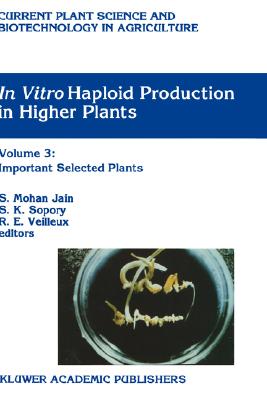
In Vitro Haploid Production in Higher Plants: Volume 5 -- Oil, Ornamental and Miscellaneous Plants - Hardcover
$168.99
$169.99
-1%Quantity
01
Pay over time for orders over $35.00 with
Offers & Perks
Earn 168 points with this purchase
Added to your rewards balance after checkout.
100 points welcome bonus
Create an account and start with extra points.
Availability:In StockContributor:S. Mohan Jain, S. K. Sopory, R. E. VeilleuxSeries:Current Plant Science and Biotechnology in AgricultureTheme:Topical/EcologyPublish date:1/31/1997Pages:258
Languages:EnglishPublisher:SpringerISBN-13:9780792339793ISBN-10:0792339797UPC:9780792339793Book Category:Science, Technology & EngineeringBook Subcategory:Life Sciences, AgricultureBook Topic:Botany, Ecology, AgronomySize:9.21 x 6.14 x 0.69 inchesWeight:0.563Product ID:SC0GTGRE1Z
Since the beginning of agricultural production, there has been a continuous effort to grow more and better quality food to feed ever increasing popula- tions. Both improved cultural practices and improved crop plants have allowed us to divert more human resources to non-agricultural activities while still increasing agricultural production. Malthusian population predictions continue to alarm agricultural researchers, especially plant breeders, to seek new technologies that will continue to allow us to produce more and better food by fewer people on less land. Both improvement of existing cultivars and development of new high-yielding cultivars are common goals for breeders of all crops. In vitro haploid production is among the new technologies that show great promise toward the goal of increasing crop yields by making similar germplasm available for many crops that was used to implement one of the greatest plant breeding success stories of this century, i. e., the development of hybrid maize by crosses of inbred lines. One of the main applications of anther culture has been to produce diploid homozygous pure lines in a single generation, thus saving many generations of backcrossing to reach homozygosity by traditional means or in crops where self-pollination is not possible. Because doubled haploids are equivalent to inbred lines, their value has been appreciated by plant breeders for decades. The search for natural haploids and methods to induce them has been ongoing since the beginning of the 20th century.
Languages:EnglishPublisher:SpringerISBN-13:9780792339793ISBN-10:0792339797UPC:9780792339793Book Category:Science, Technology & EngineeringBook Subcategory:Life Sciences, AgricultureBook Topic:Botany, Ecology, AgronomySize:9.21 x 6.14 x 0.69 inchesWeight:0.563Product ID:SC0GTGRE1Z
Publisher: Springer
Edition
1997 Edition
Contributor(s)
Free shipping on orders over $75. Standard shipping takes 3-7 business days. Returns accepted within 30 days of purchase.