
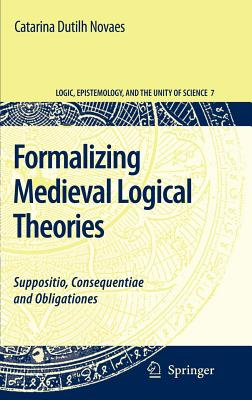
Formalizing Medieval Logical Theories: Suppositio, Consequentiae and Obligationes - Hardcover
$168.99
$169.99
-1%Quantity
01
Pay over time for orders over $35.00 with
Offers & Perks
Earn 168 points with this purchase
Added to your rewards balance after checkout.
100 points welcome bonus
Create an account and start with extra points.
Availability:In StockContributor:Catarina Dutilh NovaesSeries:Logic, Epistemology, and the Unity of ScienceTheme:Chronological Period/Medieval (500-1453) Studies, Interdisciplinary Studies/Medieval (500-1453) StudiesPublish date:4/19/2007Pages:316
Languages:EnglishPublisher:SpringerISBN-13:9781402058523ISBN-10:1402058527UPC:9781402058523Book Category:Philosophy, ReferenceBook Subcategory:Logic, History & Surveys, Bibliographies & IndexesBook Topic:MedievalSize:9.21 x 6.14 x 0.75 inchesWeight:0.636Product ID:SCYSVK50VH
Perhaps one of the most striking characteristics of later medieval philosophy and science is the remarkable unity with which the different fields of investigation were articulated to each other, in particular with respect to the methodology used. While it is fair to say that current science is characterized by a plurality of methodologies and by a high degree of specialization in each discipline, in the later medieval period there was one fundamental methodology being used across disciplines, namely logic. One can say without hesitation that logic provided unity to knowledge and science in the later medieval times. Logic (which was then understood more broadly than it is now, including semantics and formal epistemology) was one of the first subject-matters in the medieval curriculum; it was thought that the knowledge of logic was a necessary, methodological requirement for a student to move on to the other disciplines. And indeed, the widespread use of this logical and semantic methodology can be perceived in disciplines as diverse as natural philosophy (physics), theology, ethics and even medicine. Besides the fact that medieval logic provided unity to science then, while modern logic does not play the same role now (if anything at all, it is mathematics that might be considered as the fundamental methodology for current investigations), it is also widely acknowledged that the medieval and modern traditions in logic are very d- similar in many other respects.
Languages:EnglishPublisher:SpringerISBN-13:9781402058523ISBN-10:1402058527UPC:9781402058523Book Category:Philosophy, ReferenceBook Subcategory:Logic, History & Surveys, Bibliographies & IndexesBook Topic:MedievalSize:9.21 x 6.14 x 0.75 inchesWeight:0.636Product ID:SCYSVK50VH
Publisher: Springer
Edition
2007 Edition
Contributor(s)
Author
Free shipping on orders over $75. Standard shipping takes 3-7 business days. Eligible items may be returned within 30 days of delivery. Conditions apply.