
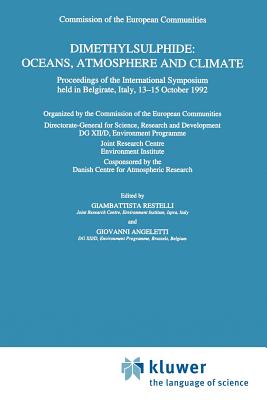
Dimethylsulphide: Oceans, Atmosphere and Climate: Proceedings of the International Symposium Held in Belgirate, Italy, 13-15 October 1992 - Paperback
$168.99
$169.99
-1%Quantity
01
Pay over time for orders over $35.00 with
Offers & Perks
Earn 168 points with this purchase
Added to your rewards balance after checkout.
100 points welcome bonus
Create an account and start with extra points.
Availability:In StockContributor:G. Restelli, G. AngelettiSeries:Air Pollution Research ReportsTheme:Topical/EcologyPublish date:12/1/2010Pages:400
Languages:EnglishPublisher:SpringerISBN-13:9789048143252ISBN-10:904814325XUPC:9789048143252Book Category:Science, NatureBook Subcategory:Earth Sciences, Ecosystems & Habitats, Life SciencesBook Topic:Meteorology & Climatology, Lakes, Ponds & Swamps, EcologySize:9.21 x 6.14 x 0.85 inchesWeight:0.577Product ID:SCC2AHAAK2
Since the discovery by J. E. Lovelock, R. J. Maggs and R. A. Rasmussen, in 1972, of its ubiquity in sea water, dimethyl sulphide (DMS), a biologically produced sulphur compound, has been the subject of continuously increasing interest by the scientific community. DMS was immediately recognized as an important component of the biogeochemical sulphur cycle, and is now indicated as the second most important source of sulphur in the atmosphere, after anthropogenic so emission from fossil fuel combustion and 2 industry. DMS reacts rapidly in the atmosphere where it is oxidized to condensable acidic sulphur products; in fact, rainwater acidification, observed in remote areas, is attributed to DMS emissions. The hypothesis of a climatic role of DMS was made already in 1983 by B. Shaw, and by B. C. Nguyen, B. Bonsang and A. Gaudry. In 1987, a study appeared in Nature, in. which R. J. Charlson, J. E. Lovelock, M. O. Andreae and S. G. Warren suggested the possibility of a partial control of the climate by the biosphere through a chain of processes, linking production of DMS by marine phytoplankton with changes in clouds albedo. The publication of this paper triggered a strong debate and stimulated new efforts to describe the various aspects of the DMS cycle in the environment. The paper was timely and added to the discussion on the relative roles of atmospheric sulphur and greenhouse gases in the Earth's radiative budget.
Languages:EnglishPublisher:SpringerISBN-13:9789048143252ISBN-10:904814325XUPC:9789048143252Book Category:Science, NatureBook Subcategory:Earth Sciences, Ecosystems & Habitats, Life SciencesBook Topic:Meteorology & Climatology, Lakes, Ponds & Swamps, EcologySize:9.21 x 6.14 x 0.85 inchesWeight:0.577Product ID:SCC2AHAAK2
Publisher: Springer
Contributor(s)
Free shipping on orders over $75. Standard shipping takes 3-7 business days. Eligible items may be returned within 30 days of delivery. Conditions apply.