Surprise Castle
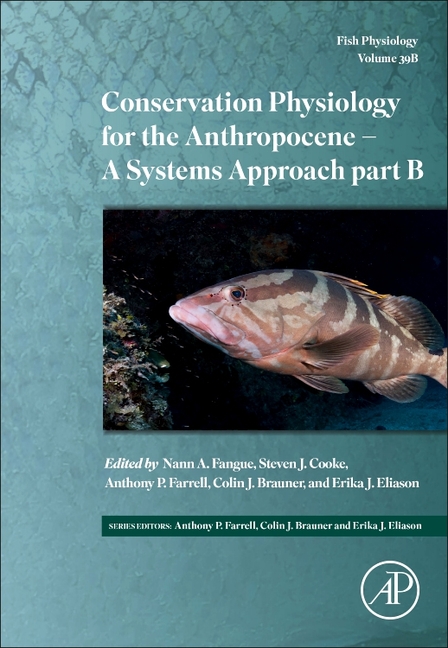
Conservation Physiology for the Anthropocene - Issues and Applications: Volume 39b

Conservation Physiology for the Anthropocene - Issues and Applications: Volume 39b - Hardcover

$131.99
Quantity
01

Pay over time for orders over $35.00 with

Offers & Perks

Earn 131 points with this purchase

Added to your rewards balance after checkout.

100 points welcome bonus

Create an account and start with extra points.

Join now
Availability:In StockContributor:Nann A. Fangue, Steven J. Cooke, Anthony P. FarrellSeries:Fish PhysiologyPublish date:11/17/2022Pages:668
Languages:EnglishPublisher:Academic PressISBN-13:9780128242681ISBN-10:012824268XUPC:9780128242681Book Category:Science, Technology & EngineeringBook Subcategory:Life Sciences, Fisheries & Aquaculture, AgricultureBook Topic:Zoology, Animal HusbandrySize:9.00 x 6.00 x 1.44 inchesWeight:1.058Product ID:SC2YTEW8Q1

Conservation Physiology for the Anthropocene - A Systems Approach, Volume 39B in the Fish Physiology series, is a comprehensive synthesis related to the physiology of fish in the Anthropocene. This volume helps solve knowledge gaps by considering the many ways in which different physiological systems (e.g., sensory physiology, endocrine, cardio-respiratory, bioenergetics, water and ionic balance and homeostasis, locomotion/biomechanics, gene function) and physiological diversity are relevant to the management and conservation of fish and fisheries. Chapters in this release include Using physiology for recovering imperiled species - the Delta smelt, Conservation hatcheries - the Sturgeon story, Aquatic pollutants and stressors, and more.

Other sections discuss Fisheries interactions in a multi-stressor world, Environmental change in riverine systems - Amazon basin stressors, Environmental change in lakes and wetlands - East African basin stressors, Coral reef fish in a multi-stressor world, Polar fish in a multi-stressor world, Physiology informs fisheries restoration and habitat management, A physiological perspective on fish passage and entrainment, Invasive species control and management - the sea lamprey story, and On the conservation physiology of fishes for tomorrow.

Languages:EnglishPublisher:Academic PressISBN-13:9780128242681ISBN-10:012824268XUPC:9780128242681Book Category:Science, Technology & EngineeringBook Subcategory:Life Sciences, Fisheries & Aquaculture, AgricultureBook Topic:Zoology, Animal HusbandrySize:9.00 x 6.00 x 1.44 inchesWeight:1.058Product ID:SC2YTEW8Q1
Fangue, Nann A.: - Dr. Nann Fangue is a Professor of Physiological Ecology and Conservation and Department Chair in the Wildlife, Fish, and Conservation Biology at the University of California Davis. She completed a BSc in Marine Biology (1999) and MSc in Biology (2002) at the University of West Florida in Pensacola. She went on for a PhD in Zoology (2007) at the University of British Columbia and held a National Science Foundation postdoctoral fellowship at UC Santa Barbara before moving to her current faculty position at UC Davis in 2009. Studies in the Fangue lab are largely focused on determining the ecological significance of physiological variation in aquatic species that inhabit nature and anthropogenically-challenging environments. A key goal of her research is to provide strategies designed to minimize environmental impacts, rebuild wildlife populations, restore ecosystems, inform conservation policy, generate decision-support tools and manage natural aquatic resources. The Fangue lab is composed of a large research team of postdoctoral scholars, graduate and undergraduate students, and technical staff, and we are committed to a safe, inclusive, diverse, optimistic and equitable research environment. Dr. Fangue has received numerous advising awards including the faculty excellence award from NACADA: The Global Community for Academic Advising in 2017. Dr. Fangue serves on the editorial board of the journal "Conservation Physiology" and is a UC Davis Chancellor's Fellow.Cooke, Steven J.: - Dr. Steven Cooke is a Professor of Fish Ecology and Conservation Physiology in the Department of Biology at Carleton University. He is also the Director of the Institute of Environmental and Interdisciplinary Science. He completed his undergrad and MSc at the University of Waterloo and his PhD at the University of Illinois before holding an NSERC and Killam Post Doctoral Fellowship at UBC. His research interests are diverse but tend to focus on the behaviour and physiology of wild fish in both freshwater and marine systems. His work spans the entirety of the fundamental-applied continuum and involves work in the lab and the field. He is particularly well known for his work on fish migration, recreational fisheries science, fish-hydropower interactions, and the ecology of stress. He is a Clarivate Highly Cited Researcher and has over 800 peer reviewed publications. Cooke is also the founding Director of the Canadian Centre for Evidence-Based Conservation where he leads a team conductive evidence syntheses. He is founding editor of the Oxford University Press journal "Conservation Physiology". From 2009 to 2019 Cooke held a Tier II Canada Research Chair and in 2015 he was selected as an NSERC E.W.R. Steacie Fellow. Cooke holds a number of leadership positions including Chair of the Sea Lamprey Research Board of the Great Lakes Fishery Commission and Secretary of the College of the Royal Society of Canada.Farrell, Anthony P.: - Dr. Tony Farrell is a Professor Emeritus in the Department of Zoology & Faculty of Land and Food Systems at the University of British Columbia and a Fellow of the Royal Society of Canada. His research had provided an understanding of fish cardiorespiratory systems and has applied this knowledge to salmon migratory passage, fish stress handling and their recovery, sustainable aquaculture and aquatic toxicology. He has over 490 research publications in peer-reviewed scientific journals and an h-factor of 92. He has co-edited of 30 volumes of the Fish Physiology series, as well as an award-winning Encyclopedia of Fish Physiology. As part of his application of physiology to aquaculture, he has studied the sub-lethal impacts of sea lice and piscine orthoreovirus on the physiology of juvenile salmon. Dr. Farrell has received multiple awards, including the Fry Medal, which is the highest honour to a scientist from the Canadian Society of Zoologists, the Beverton Medal, which is the highest honour to a scientist from the Fisheries Society of the British Isles, the Award of Excellence, which is the highest honour of the American Fisheries Society and the Murray A. Newman Awards both for Research and for Conservation from the Vancouver Marine Sciences Centre. He is a former President of the Society of Experimental Biologists and a former Editor-in-Chief for the Journal of Fish Biology. He served as a member of the Minister's Aquaculture Advisory Committee on Finfish Aquaculture for British Columbia and was a member of the Federal Independent Expert Panel on Aquaculture Science.
Et al...
Publisher: Academic Press

Free shipping on orders over $75. Standard shipping takes 3-7 business days. Returns accepted within 30 days of purchase.