
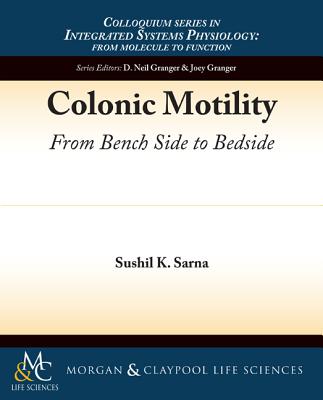
Colonic Motility: From Bench Side to Bedside - Paperback
$44.99
$45.00
Quantity
01
Pay over time for orders over $35.00 with
Offers & Perks
Earn 44 points with this purchase
Added to your rewards balance after checkout.
100 points welcome bonus
Create an account and start with extra points.
Availability:In StockContributor:Sushil K. SarnaSeries:Colloquium Integrated Systems Physiology: From Molecule to Function to DiseasePublish date:1/10/2011Pages:157
Languages:EnglishPublisher:Morgan & ClaypoolISBN-13:9781615041503ISBN-10:1615041508UPC:9781615041503Book Category:ScienceBook Subcategory:Life SciencesBook Topic:Human Anatomy & Physiology, Evolution, BiologySize:9.25 x 7.50 x 0.33 inchesWeight:0.281Product ID:SC9XZQKRHR
Three distinct types of contractions perform colonic motility functions. Rhythmic phasic contractions (RPCs) cause slow net distal propulsion with extensive mixing/turning over. Infrequently occurring giant migrating contractions (GMCs) produce mass movements. Tonic contractions aid RPCs in their motor function. The spatiotemporal patterns of these contractions differ markedly. The amplitude and distance of propagation of a GMC are several-fold larger than those of an RPC. The enteric neurons and smooth muscle cells are the core regulators of all three types of contractions. The regulation of contractions by these mechanisms is modifiable by extrinsic factors: CNS, autonomic neurons, hormones, inflammatory mediators, and stress mediators. Only the GMCs produce descending inhibition, which accommodates the large bolus being propelled without increasing muscle tone. The strong compression of the colon wall generates afferent signals that are below nociceptive threshold in healthy subjects. However, these signals become nociceptive; if the amplitudes of GMCs increase, afferent nerves become hypersensitive, or descending inhibition is impaired. The GMCs also provide the force for rapid propulsion of feces and descending inhibition to relax the internal anal sphincter during defecation. The dysregulation of GMCs is a major factor in colonic motility disorders: irritable bowel syndrome (IBS), inflammatory bowel disease (IBD), and diverticular disease (DD). Frequent mass movements by GMCs cause diarrhea in diarrhea predominant IBS, IBD, and DD, while a decrease in the frequency of GMCs causes constipation. The GMCs generate the afferent signals for intermittent short-lived episodes of abdominal cramping in these disorders. Epigenetic dysregulation due to adverse events in early life is one of the major factors in generating the symptoms of IBS in adulthood. Table of Contents: Introduction / Regulatory Mechanisms / Colonic Motility in Health / Colonic Motility Dysfunction / References
Languages:EnglishPublisher:Morgan & ClaypoolISBN-13:9781615041503ISBN-10:1615041508UPC:9781615041503Book Category:ScienceBook Subcategory:Life SciencesBook Topic:Human Anatomy & Physiology, Evolution, BiologySize:9.25 x 7.50 x 0.33 inchesWeight:0.281Product ID:SC9XZQKRHR
Sarna, Sushil K.: - University of Texas Medical Branch
Publisher: Morgan & Claypool
Contributor(s)
Author
Free shipping on orders over $75. Standard shipping takes 3-7 business days. Returns accepted within 30 days of purchase.