
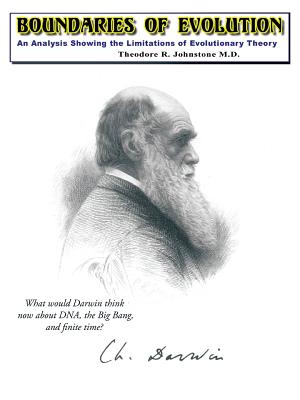
Boundaries of Evolution: What Would Darwin Think Now about DNA, the Big Bang, and Finite Time? - Paperback
$12.99
Quantity
01
Pay over time for orders over $35.00 with
Offers & Perks
Earn 12 points with this purchase
Added to your rewards balance after checkout.
100 points welcome bonus
Create an account and start with extra points.
Languages:EnglishPublisher:Trafford PublishingISBN-13:9781490745664ISBN-10:1490745661UPC:9781490745664Book Category:ScienceBook Subcategory:Life SciencesBook Topic:Biology, EvolutionSize:11.00 x 8.25 x 0.43 inchesWeight:0.468Product ID:SCF5D6G7V5
Boundaries of Evolution describes the unlikelihood of evolutionary theory to explain how it is supposed to scale three major biological cliffs. The first cliff is the need for a logical explanation of how random chemical reactions could produce the first living cell from the primordial soup. The second is the problem of explaining how the first single-celled eukaryote evolved from a prokaryote. Mathematical improbabilities of evolutionary theory to scale the first two cliffs, in the time available, are demonstrated. The third insurmountable cliff is the necessity for a reasonable explanation of how millions of different kinds of multi-celled eukaryotes could have quickly evolved from single-celled eukaryotes. Random mutations occurring in DNA, accepted or rejected by natural selection, are hailed as the source of advancement for the increase in biotic complexity. The most common time for mutations to occur in the DNA is during replication. Therefore, evolutionary advancement should occur faster in biota with the most frequent replication cycles. If both evolutionary theory and the fossil record are correct, prokaryotes, which replicate in as little as 20 minutes took 2 billion years to evolve the first single-celled eukaryote. Single-celled eukaryotes, generally having shorter reproductive times than multi-celled eukaryotes, took another billion years to evolve the first multi-celled eukaryote. Then during Cambrian times, the multi-celled eukaryotes with the longest reproductive cycles literally exploded in diversity in a comparatively short time. How could this be? Other inadequacies of Darwin's theory are presented for everyone to see.
Languages:EnglishPublisher:Trafford PublishingISBN-13:9781490745664ISBN-10:1490745661UPC:9781490745664Book Category:ScienceBook Subcategory:Life SciencesBook Topic:Biology, EvolutionSize:11.00 x 8.25 x 0.43 inchesWeight:0.468Product ID:SCF5D6G7V5
Free shipping on orders over $75. Standard shipping takes 3-7 business days. Returns accepted within 30 days of purchase.