
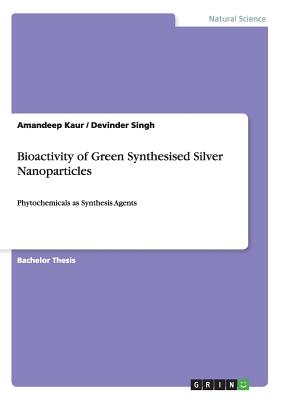
Bioactivity of Green Synthesised Silver Nanoparticles: Phytochemicals as Synthesis Agents - Paperback
$58.99
$67.90
-13%Quantity
01
Pay over time for orders over $35.00 with
Offers & Perks
Earn 58 points with this purchase
Added to your rewards balance after checkout.
100 points welcome bonus
Create an account and start with extra points.
Languages:EnglishPublisher:Grin VerlagISBN-13:9783656946397ISBN-10:3656946396UPC:9783656946397Book Category:ScienceBook Subcategory:Life SciencesBook Topic:BiologySize:8.27 x 5.83 x 0.22 inchesWeight:0.132Product ID:SC5MS45343
Bachelor Thesis from the year 2013 in the subject Biology - Miscellaneous, grade: M.Sc., course: Biotechnology, language: English, abstract: Research and analysis of nanoparticles (NPs) synthesis and their biological activities has been expanded significantly in the recent years. The agents used for nanoparticles (NPs) synthesis are of organic (mainly carbon) and inorganic (metal ions like silver and gold) origin (Singh et al., 2010). Among these, silver (Ag) is the most preferred NPs synthesis agent due to its reported use in medical field as best topical bactericides from ancient times (Lavanya et al., 2013). The stable silver nanoparticles had been synthesized by using soluble starch as both the reducing and stabilizing agents (Shrivastava et al., 2012). So the concern of scientific community shifted towards ecofriendly, natural and cheaper method of NPs synthesis by using microorganisms and plant extracts (Mohanpuria et al., 2008). The use of plant materials for silver nanoparticles (AgNPs) is most popular due to its potential biological activities, easy availability and faster rate of synthesis there by cutting the cost of NP's synthesis (Huang et al., 2007 and Salam et al., 2012). The nanoparticles had been clinically used for infection, vaccines and renal diseases (Malhotra et al., 2010). The plant extract of petals of herbal species like Punica granatum, Datura metel (Chandran et al., 2011) and stem extracts of Svensonia hyderobadensis (Linga et al., 2011) had been effectively used for AgNPs synthesis and investigated for their antimicrobial activities. Nanoparticles could be synthesized by various approaches like photochemical reactions in reverse micelles (Taleb et al., 1997), thermal decomposition (Esumi et al., 1990), sonochemical (Zhu et al., 2000) and microwave assisted process (Santosh et al., 2002 and Prasher et al., 2009). Nanocrystalline silver particles have found tremendous applications in the field of high sensitivity biomolecular detection an
Languages:EnglishPublisher:Grin VerlagISBN-13:9783656946397ISBN-10:3656946396UPC:9783656946397Book Category:ScienceBook Subcategory:Life SciencesBook Topic:BiologySize:8.27 x 5.83 x 0.22 inchesWeight:0.132Product ID:SC5MS45343
Publisher: Grin Verlag
Contributor(s)
Authors
Free shipping on orders over $75. Standard shipping takes 3-7 business days. Returns accepted within 30 days of purchase.