
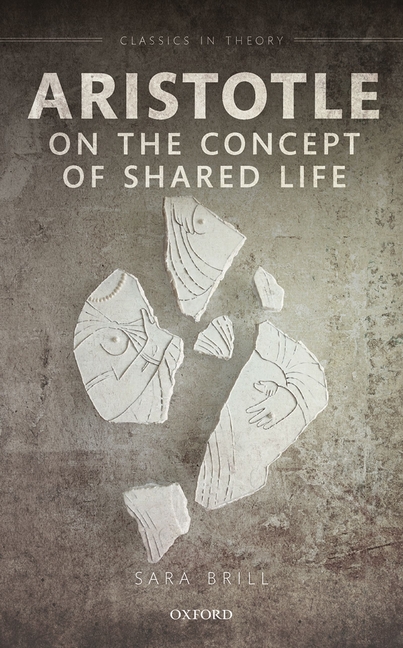
Aristotle on the Concept of Shared Life - Hardcover
by Sara Brill
$151.99
Quantity
01
Pay over time for orders over $35.00 with
Offers & Perks
Earn 151 points with this purchase
Added to your rewards balance after checkout.
100 points welcome bonus
Create an account and start with extra points.
Availability:In StockContributor:Sara BrillSeries:Classics in TheoryTheme:Chronological Period/Ancient (To 499 A.D.)Publish date:7/28/2020Pages:296
Languages:EnglishPublisher:Oxford University PressISBN-13:9780198839583ISBN-10:0198839588UPC:9780198839583Book Category:PhilosophyBook Subcategory:History & Surveys, PoliticalBook Topic:Ancient & ClassicalSize:8.60 x 5.50 x 0.90 inchesWeight:0.477Product ID:SCK4Z09V3A
According to the terms of Aristotle's Politics, to be alive is to instantiate a form of rule. In the growth of plants, the perceptual capacities and movement of animals, and the impulse that motivates thinking, speaking, and deliberating Aristotle sees the working of a powerful generative force come to expression in an array of forms of life, and it is in these, if anywhere, that one could find the resources needed for a philosophic account of the nature of life as such. Aristotle on the Concept of Shared Life explores this intertwining of power and life in Aristotle's thought, and argues that Aristotle locates the foundation of human political life in the capacity to share one's most vital activities with others. A comprehensive study of the relationality which shared life reveals tells us something essential about Aristotle's approach to human political phenomena; namely, that they arise as forms of intimacy whose political character can only be seen when viewed in the context of Aristotle's larger inquiries into animal life, where they emerge not as categorically distinct from animal sociality, but as intensifications of it. Tracing the human capacity to share life thus illuminates the interrelation between the zoological, ethical, and political lenses through which Aristotle pursues his investigation of the polis. In following this connection, this volume also examines -- and critically evaluates -- the reception of Aristotle's political thought in some of the most influential concepts of contemporary critical theory.
Languages:EnglishPublisher:Oxford University PressISBN-13:9780198839583ISBN-10:0198839588UPC:9780198839583Book Category:PhilosophyBook Subcategory:History & Surveys, PoliticalBook Topic:Ancient & ClassicalSize:8.60 x 5.50 x 0.90 inchesWeight:0.477Product ID:SCK4Z09V3A
Sara Brill, Professor of Philosophy, Fairfield University Sara Brill is Professor of Philosophy at Fairfield University, where she has also served as Chair of the Classical Studies Program. She works on the psychology, politics, and ethics of Plato and Aristotle, as well as broader questions of embodiment, life, and power as points of intersection between ancient Greek philosophy and literature and contemporary critical theory. She is the author of Plato on the Limits of Human Life (Indiana University Press, 2013) and the co-editor of Antiquities Beyond Humanism (with Emanuela Bianchi and Brooke Holmes; OUP, 2019), and has also published numerous articles on Plato, Aristotle, Greek tragedy, and the Hippocratic corpus.
Publisher: Oxford University Press
Contributor(s)
Author
Free shipping on orders over $75. Standard shipping takes 3-7 business days. Eligible items may be returned within 30 days of delivery. Conditions apply.