
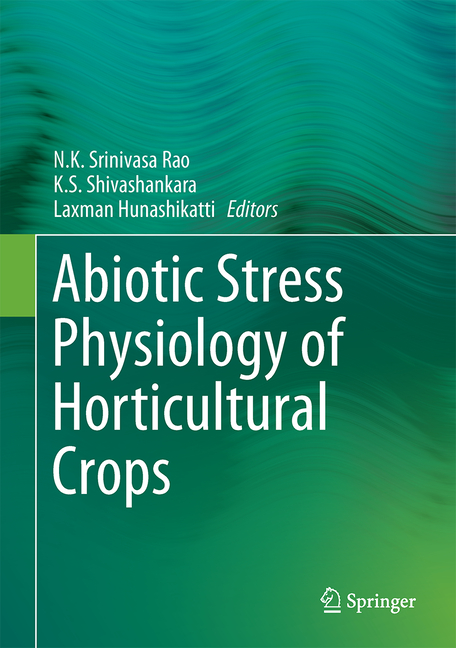
Abiotic Stress Physiology of Horticultural Crops - Hardcover
Pay over time for orders over $35.00 with
Offers & Perks
Earn 168 points with this purchase
Added to your rewards balance after checkout.
100 points welcome bonus
Create an account and start with extra points.
Dr. N. K. Srinivasa Rao, Principal Scientist (Plant Physiology-Retd.) and Ex Emeritus Scientist, Indian Institute of Horticultural Research, Bangalore, was born on 31.01.1950 at Bangalore. He belongs to the first batch of Agricultural Research Service. He has passed ARS examination with first rank and the joined ICAR service on 29.11.1976 at IIHR, Bangalore in the discipline of Plant Physiology. He has contributed significantly to the understanding of mechanism of abiotic stress tolerance in horticultural crops.
Some of his publications are:
1.Srinivasa Rao, N.K. and Bhatt, R.M. (1990) Response of photosynthesis to Water stress in two eggplant Cultivars (Solanum melongena L.) Photosynthetica, 24:
2. Srinivasa Rao, N.K. and Bhatt, R.M.(1990). Effect of two temperature regimes on photosynthesis and growth in two cultivars of tomato (Lycopersicon esculentum Mill.). Photosynthetica 26: 625-63
Dr. Kodthalu Seetharamaiah Shivashankara is currently working as principal scientist in Indian Institute of Horticultural Research, Bangalore.
Some of his publications are:1) Sheshshayee, M.S., Shivashankara, K.S., Ramaswamy, G.S., Davendra, R., Shankar, A.G., Prasad, T.G., Udaya Kumar, M.,1991. A new method to generate different CO2 concentrations to develop CO2 response curves. Curr. Sci., 62: 538-540.
2) Shivashankara, K.S., Mithila, J and Maiti, S., 2000. A new method for vegetative multiplication of betelvine. J. Plantation Crops. 28(2): 94-98Dr. Laxman Ramanna Hunashikatti is currently working as principal scientist in ICAR-Indian Institute of Horticultural Research, Bengaluru.
Edition
2016 Edition
Contributor(s)
Free shipping on orders over $75. Standard shipping takes 3-7 business days. Eligible items may be returned within 30 days of delivery. Conditions apply.