
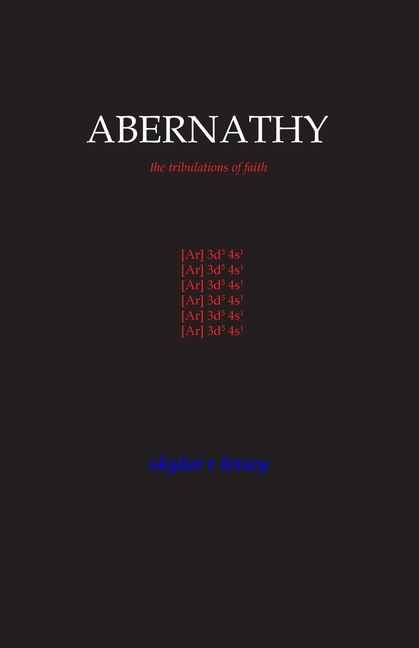
Abernathy: the tribulations of faith - Paperback
Pay over time for orders over $35.00 with
Offers & Perks
Earn 18 points with this purchase
Added to your rewards balance after checkout.
100 points welcome bonus
Create an account and start with extra points.
Skylar R. Leisey is an American writer and engineer whose work examines identity, suffering, transformation, and the psychology of self-perception. Drawing from personal experience and philosophical inquiry, he writes with direct intensity on fear, love, generational cycles, and the tension between who we are and who we attempt to become. His work operates within the tradition of Western philosophical introspection, engaging questions of moral duality, internal contradiction, and the enduring presence of both good and evil within the individual.
Leisey wrote Abernathy at the age of seventeen, later publishing the work at twenty and republishing it at twenty-three. Emerging from a later stage of development than his debut, the work reflects a shift in perspective-less concerned with identifying internal struggle and more focused on confronting it directly. Where earlier writing captures awareness, Abernathy advances into examination, resistance, and consequence.
As the second volume in a five-part philosophical poetry series, Abernathy deepens the foundation established in Baywater. It explores the mechanisms that govern internal conflict: control and the illusion of control, attachment and its distortions, self-sabotage, and the recursive patterns that define human behavior across time. The work does not attempt to resolve these tensions; rather, it isolates them, presenting the mind as an active and often opposing force-one that shapes perception, distorts meaning, and challenges the individual's capacity for clarity and direction.
Central to Abernathy is the idea that good and evil are not external absolutes but internal conditions that coexist and compete within the same framework of thought. The work examines how these forces manifest in decision-making, relationships, and self-judgment, emphasizing ambiguity over certainty. In doing so, it aligns with a broader philosophical tradition that views identity not as fixed, but as continuously constructed through conflict, reflection, and response.
The tone of Abernathy is more deliberate and sharpened than its predecessor, reflecting a progression from observation to confrontation. It carries a heightened awareness of consequence-how internal patterns, if left unexamined, repeat across time and across generations. This introduces a structural emphasis on cycles: inherited behaviors, learned responses, and the difficulty of breaking from them. The work positions transformation not as a singular event, but as an ongoing process that requires recognition, resistance, and sustained effort.
Abernathy is the second installment in a five-part poetic structure that parallels Leisey's larger narrative project, A Story of Cardinals. While the remaining poetry volumes and the five-part saga are forthcoming, both bodies of work are intentionally aligned. The poetry serves as a distilled internal record-philosophical, psychological, and abstract-while the saga expands these same themes outward into narrative form, exploring identity, control, suffering, and meaning across a broader external framework.
Together, these parallel structures form a unified body of work. The poetry examines the internal architecture of thought and emotion, while the narrative explores how those internal forces manifest in action, consequence, and environment. Within this framework, Abernathy functions as a transitional piece-bridging awareness and confrontation, and establishing the deeper philosophical questions that continue to unfold across both series.
Edition
The Originals Edition
Contributor(s)
Author
Free shipping on orders over $75. Standard shipping takes 3-7 business days. Eligible items may be returned within 30 days of delivery. Conditions apply.