
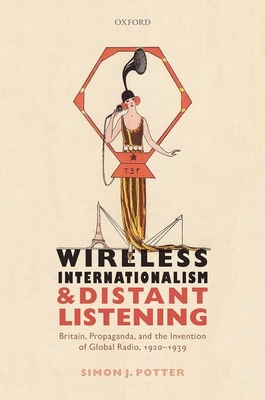
Wireless Internationalism and Distant Listening: Britain, Propaganda, and the Invention of Global Radio, 1920-1939 - Hardcover
$114.99
Quantity
01
Pay over time for orders over $35.00 with
Offers & Perks
Earn 114 points with this purchase
Added to your rewards balance after checkout.
100 points welcome bonus
Create an account and start with extra points.
Availability:In StockContributor:Simon J. PotterTheme:Chronological Period/20th CenturyPublish date:8/4/2020Pages:258
Languages:EnglishPublisher:Oxford University PressISBN-13:9780198800231ISBN-10:0198800231UPC:9780198800231Book Category:HistoryBook Subcategory:Modern, Social History, EuropeBook Topic:20th CenturySize:9.30 x 6.40 x 0.90 inchesWeight:0.545Product ID:SC4ZSHWGGN
During the 1920s and 1930s the new medium of radio broadcasting promised to transform society by fostering national unity and strengthening and popularising national cultures. However, many hoped that 'wireless' would also encourage international understanding and world peace. Intentionally or otherwise, wireless signals crossed borders, bringing talk, music, and news to enthusiastic 'distant listeners' in other countries. In Europe, radio was regulated through international consultation and cooperation, to restrict interference between stations, and to unleash the medium's full potential to carry programmes to global audiences. A distinctive form of 'wireless internationalism' emerged, reflecting and reinforcing the broader internationalist movement and establishing structures and approaches which endured into the Second World War, the Cold War, and beyond. This study reveals this untold history. Wireless Internationalism and Distant Listening also explores the neglected interwar experience of distant listening, revealing the prevalence of listening across borders and explaining how individuals struggled to overcome unwanted noise, tune in as many stations as possible, and comprehend and enjoy what they heard. The volume shows how radio brought the world to Britain, and Britain to the world. It revises our understanding of early BBC broadcasting and the BBC Empire Service (the precursor to today's World Service) and shows how government influence shaped early BBC international broadcasting in English, Arabic, Spanish, and Portuguese. It also explores the wider European and trans-Atlantic context, demonstrating how Fascism in Italy and Germany, the Spanish Civil War, and the Japanese invasion of China, combined to overturn the utopianism of the 1920s and usher in a new era of wireless nationalism.
Languages:EnglishPublisher:Oxford University PressISBN-13:9780198800231ISBN-10:0198800231UPC:9780198800231Book Category:HistoryBook Subcategory:Modern, Social History, EuropeBook Topic:20th CenturySize:9.30 x 6.40 x 0.90 inchesWeight:0.545Product ID:SC4ZSHWGGN
Simon J. Potter, Professor of Modern History, University of Bristol Simon J. Potter is Professor of Modern History at the University of Bristol. He has published widely on the history of the mass media and the history of empire, and his work brings together themes, ideas, and debates from these two fields. He has also written extensively on the wider historiographies of the British Empire and the British World, and on recent developments in Global History. His publications include Broadcasting Empire: the BBC and the British World, 1922-1970 (2012), British Imperial History (2015), and News and the British World: the Emergence of an Imperial Press System, 1876-1922 (2003). He has led a Leverhulme Trust International Network on global radio history and worked with heritage groups in Bristol on public engagement with the legacies of empire.
Publisher: Oxford University Press
Contributor(s)
Author
Free shipping on orders over $75. Standard shipping takes 3-7 business days. Eligible items may be returned within 30 days of delivery. Conditions apply.