
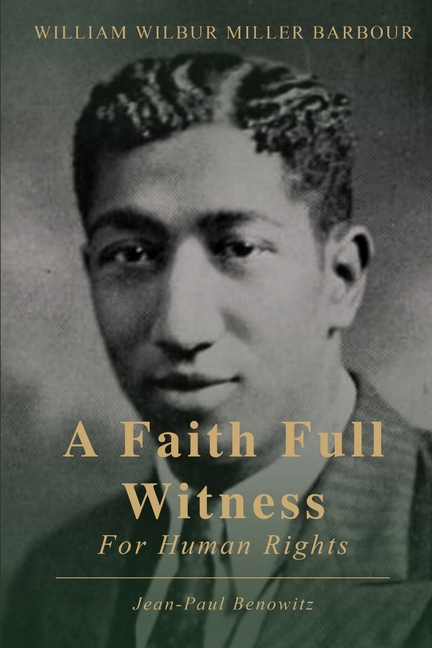
William Wilbur Miller Barbour: A Faith Full Witness for Human Rights - Paperback
$17.99
$24.99
-28%Quantity
01
Pay over time for orders over $35.00 with
Offers & Perks
Earn 17 points with this purchase
Added to your rewards balance after checkout.
100 points welcome bonus
Create an account and start with extra points.
Availability:In StockContributor:Jean-Paul BenowitzTheme:Chronological Period/20th CenturyPublish date:5/22/2026Pages:296
Languages:EnglishPublisher:Santos BooksISBN-13:9798994893821UPC:9798994893821Book Category:Biography & Autobiography, Political Science, HistoryBook Subcategory:Social Activists, Civil Rights, United StatesBook Topic:20th CenturySize:9.00 x 6.00 x 0.62 inchesWeight:0.4Product ID:SC2BW15QJG
What began as a question about a face in a photograph became, in time, one of the most important questions a biographer can askabout the past: not merely who was this person, but what did hislife cost him, what did it build, and what does it ask of us? WilliamWilbur Miller Barbour left no autobiography, no collection of privateletters, no public monument with his name on it. He left instead theharder thing: a career of twenty-five years spent in the spaces betweenthe law's promise and American life's reality, doing the work the lawcould not do, building the conditions for genuine human communityin cities where the word community was used to describe what racialexclusion had produced and preserved. He died at forty-nine, in LosAngeles, in March 1957. He had been working all week. He was stillworking when his heart gave out. The movement he had been buildingtoward since his graduation from Elizabethtown College in 1932would culminate, in the Civil Rights Act of 1964, the Voting RightsAct of 1965, and the Fair Housing Act of 1968, in legislation he did notlive to see signed. He was a builder of foundations. He never saw thestructure rise.Barbour learned, in ways no classroom could teach, what it meant tolabor against odds for something larger than oneself. He built foundations.He laid groundwork. He worked in the soil of human rightsand human dignity at a moment when the harvest was nowhere insight, when the arc of history showed no visible signs of bending inthe direction anyone who cared about justice might have wished. Hedid not live to see what rose from what he planted.He brought to the work a dual formation few men of his generationcould claim. The Anabaptist and Pietist tradition of the Church of theBrethren had pressed into him, during his years as a student at ElizabethtownCollege, a mandate both institutional and theological. Theprophetic tradition of the African Methodist Episcopal Church hadformed him from childhood in a conviction equally deep and equallydemanding: racial hierarchy was incompatible with the Gospel. Thesetwo traditions arose from entirely different histories and wholly distinctexperiences of American life. In Barbour they converged on asingle claim. The Declaration meant what it said. The Gospel demandedits fulfillment. The gap between democratic promise anddemocratic practice was not a fact to be accommodated but a civicfailure to be opposed, by specific, costly, theologically grounded work, in specific cities, in institutional settings, for as long as it took.He spent twenty-five years opposing it. At the Semiquincentennial, itremains opposed. His story belongs to this moment.
Languages:EnglishPublisher:Santos BooksISBN-13:9798994893821UPC:9798994893821Book Category:Biography & Autobiography, Political Science, HistoryBook Subcategory:Social Activists, Civil Rights, United StatesBook Topic:20th CenturySize:9.00 x 6.00 x 0.62 inchesWeight:0.4Product ID:SC2BW15QJG
Free shipping on orders over $75. Standard shipping takes 3-7 business days. Returns accepted within 30 days of purchase.