
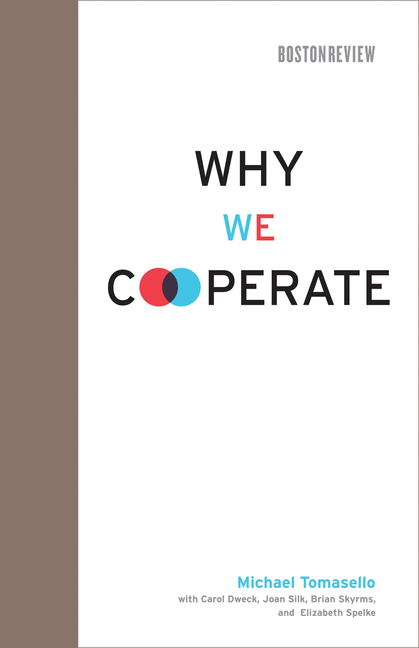
Why We Cooperate - Paperback
$21.99
Quantity
01
Pay over time for orders over $35.00 with
Offers & Perks
Earn 21 points with this purchase
Added to your rewards balance after checkout.
100 points welcome bonus
Create an account and start with extra points.
Availability:In StockContributor:Michael Tomasello, Carol Dweck, Joan SilkSeries:Boston Review BooksAudience:Young AdultPublish date:5/19/2026Pages:232
Languages:EnglishPublisher:MIT PressISBN-13:9780262053945ISBN-10:0262053942UPC:9780262053945Book Category:PsychologyBook Subcategory:Developmental, Psychotherapy, Cognitive Psychology & CognitionBook Topic:Child, CounselingSize:6.94 x 4.50 x 0.72 inchesWeight:0.182Product ID:SCEV05998H
Understanding cooperation as a distinctly human combination of innate and learned behavior. Drop something in front of a two-year-old, and she's likely to pick it up for you. This is not a learned behavior, psychologist Michael Tomasello argues. Through observations of young children in experiments he himself has designed, Tomasello shows that children are naturally--and uniquely--cooperative. Put through similar experiments, for example, apes demonstrate the ability to work together and share, but choose not to. As children grow, their almost reflexive desire to help--without expectation of reward--becomes shaped by culture. They become more aware of being a member of a group. Groups convey mutual expectations, and thus may either encourage or discourage altruism and collaboration. Either way, cooperation emerges as a distinctly human combination of innate and learned behavior. In Why We Cooperate, Tomasello's studies of young children and great apes help identify the underlying psychological processes that very likely supported humans' earliest forms of complex collaboration and, ultimately, our unique forms of cultural organization, from the evolution of tolerance and trust to the creation of such group-level structures as cultural norms and institutions.
Scholars Carol S. Dweck, Joan B. Silk, Brian Skyrms, and Elizabeth S. Spelke respond to Tomasello's findings and explore the implications.
Scholars Carol S. Dweck, Joan B. Silk, Brian Skyrms, and Elizabeth S. Spelke respond to Tomasello's findings and explore the implications.
Languages:EnglishPublisher:MIT PressISBN-13:9780262053945ISBN-10:0262053942UPC:9780262053945Book Category:PsychologyBook Subcategory:Developmental, Psychotherapy, Cognitive Psychology & CognitionBook Topic:Child, CounselingSize:6.94 x 4.50 x 0.72 inchesWeight:0.182Product ID:SCEV05998H
Michael Tomasello is Professor of Psychology and Neuroscience at Duke University and Emeritus Director at the Max Planck Institute for Evolutionary Anthropology in Leipzig. His recent books include Becoming Human, The Evolution of Agency (MIT Press), and Agency and Cognitive Development.
Publisher: MIT Press
Contributor(s)
Author
Free shipping on orders over $75. Standard shipping takes 3-7 business days. Returns accepted within 30 days of purchase.