
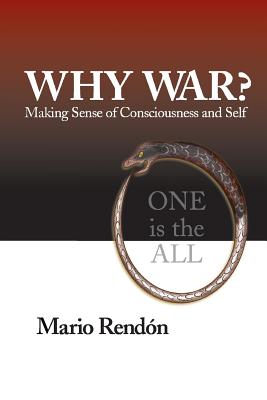
Why War?: Making Sense of Consciousness and Self - Paperback
Pay over time for orders over $35.00 with
Offers & Perks
Earn 25 points with this purchase
Added to your rewards balance after checkout.
100 points welcome bonus
Create an account and start with extra points.
From the Preface:
"Thus God and Nature link'd the gen'ral frame,
And bade Self-love and Social be the same."
Pope [i]
The Argument of Pope could be the argument of this book. It is remarkable that he wrote it in 1733 foretelling so many modern themes. That the total set of interrelations of the universe must include society (Hegel), that everything stands in relationship to everything else (Darwin), that happiness and love are reciprocal (Freud), that reason is a continuation of instinct (Darwin), that instinct produces social institutions (Veblen), that patriarchy had a historical origin as did religion, and that therefore unlike material imperatives they are reversible (Morgan, Meszaros), that governments based on love and those based on fear are antipodes (Marx), and that true self-love results in public good (Adam Smith). These are all themes of this book, based on the Spinozist principle that God and Nature are one, and therefore God is only the good sense of nature, its awesome intelligence of which humanity partakes. This shows how old the fundamental ideas of this book are. Our lack of action is not due to lack of ideas.
The title of the book expresses its main thesis. Freud got close but answering the question but his ideology blurred his vision to the dialectical nature of instinct, to the effect that altruism, the phenomenon that so productively puzzled Darwin, is his Eros, the feminine instinct. Thanatos its opposite unrestrained manifests itself in constant war today. This is based in the Freud-Einstein correspondence after, in 1931, the Institute for Intellectual Cooperation invited Einstein to a cross-disciplinary exchange of ideas about politics and peace with a thinker of his choosing. Einstein chose Freud and asked hum Why War? within the parameters of might and right that Freud, interestingly, substituted for violence and right. Einstein was hoping for a psychological explanation and Freud answered only partially and rather hopelessly through his instinctual construct of-Thanatos but rather unilaterally and mechanically.[ii] Freud did not see his contradiction: that his whole theory of culture was based on sublimation and therefore the question why is war an exception to sublimation? This book endeavors to answer this question by placing history in the psychoanalytic couch in the first part, by interpreting its trauma that repressed altruism. A deeply traumatized animal species, we ourselves inflicted the trauma when we abandoned the morality of evolution, [iii] and compromised our inherent moral uprightness.
Free shipping on orders over $75. Standard shipping takes 3-7 business days. Returns accepted within 30 days of purchase.