
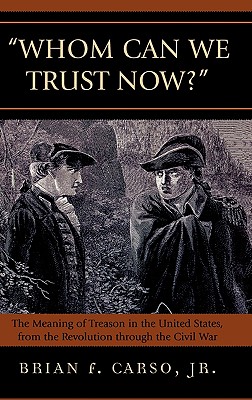
Whom Can We Trust Now?: The Meaning of Treason in the United States, from the Revolution through the Civil War - Hardcover
$142.99
Quantity
01
Pay over time for orders over $35.00 with
Offers & Perks
Earn 142 points with this purchase
Added to your rewards balance after checkout.
100 points welcome bonus
Create an account and start with extra points.
Availability:In StockContributor:Brian F. Carso, Jr.Theme:Chronological Period/18th Century, Chronological Period/19th CenturyPublish date:3/1/2006Pages:262
Languages:EnglishPublisher:Lexington BooksISBN-13:9780739112564ISBN-10:0739112562UPC:9780739112564Book Category:History, LawBook Subcategory:United States, Legal History, ConstitutionalBook Topic:19th CenturySize:9.08 x 6.30 x 0.95 inchesWeight:0.64Product ID:SC9Q9GSVC2
For several hours in August 1787, the delegates to the Philadelphia Convention debated the two sentences defining treason that would serve as the only criminal law in the U.S. Constitution. As storied and controversial as this ancient crime was, the meaning of treason for the new democratic republic was difficult to foresee. Historian and lawyer Brian Carso demonstrates that although treason law was conflicted and awkward, the broader idea of treason gave recognizable shape to abstract ideas of loyalty, betrayal, allegiance, and political obligation in the United States. Taking an interdisciplinary approach, Carso begins by exploring the nature of loyalty and betrayal in a democratic republic, using examples ranging from Socrates in Plato's Crito to the dilemma of Robert E. Lee in 1861 and the trial of Timothy McVeigh in 1997. Turning to legal history, the study considers the historical antecedents of the Treason Clause of the U.S. Constitution and examines the utility of American treason law as it was applied in a variety of cases, most notably in the 1807 trial of Aaron Burr, in which Supreme Court Justice John Marshall used twenty-five thousand words to explicate the Treason Clause. Finding that the antinomies of treason law in a democratic republic make successful prosecutions against treason nearly impossible, Carso turns to the political, intellectual, and cultural realms of civic life to identify and to explain the broader meaning of treason. The study investigates the perpetual condemnation of Benedict Arnold and the many ways treason animated civic discourse during the Civil war. By examining editorials, sermons, histories, orations, art, literature, and political cartoons, Carso identifies how the meaning of treason engaged the public imagination in a variety of compelling forms and instructed citizens on loyalty and betrayal outside the courtroom as much as within it.
Languages:EnglishPublisher:Lexington BooksISBN-13:9780739112564ISBN-10:0739112562UPC:9780739112564Book Category:History, LawBook Subcategory:United States, Legal History, ConstitutionalBook Topic:19th CenturySize:9.08 x 6.30 x 0.95 inchesWeight:0.64Product ID:SC9Q9GSVC2
Brian F. Carso, Jr., holds graduate degrees from the University of Rochester, SUNY Buffalo School of Law, and Boston University, where he received his PhD in American Studies. A practicing attorney, he has held public office in both county and state government. He is currently an assistant professor of history at College Misericordia in Dallas, Pennsylvania.
Publisher: Lexington Books
Contributor(s)
Author
Free shipping on orders over $75. Standard shipping takes 3-7 business days. Returns accepted within 30 days of purchase.