
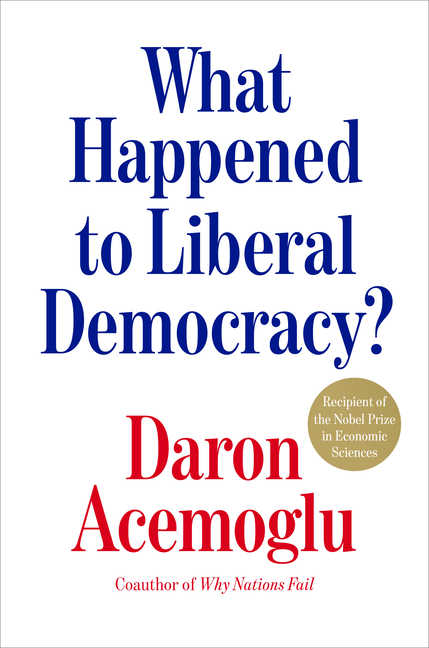
What Happened to Liberal Democracy?: Remaking a Politics of Shared Prosperity - Hardcover
$23.99
$32.00
-25%Quantity
01
Pay over time for orders over $35.00 with
Offers & Perks
Earn 23 points with this purchase
Added to your rewards balance after checkout.
100 points welcome bonus
Create an account and start with extra points.
Languages:EnglishPublisher:DuttonISBN-13:9798217182169UPC:9798217182169Book Category:Political Science, Business & EconomicsBook Subcategory:Comparative Politics, History & Theory, Economic HistorySize:9.27 x 6.28 x 1.36 inchesWeight:0.572Product ID:SC2RCVRR21
International Bestseller From Daron Acemoglu, 2024 Nobel laureate in economics and coauthor of Why Nations Fail, an ambitious and expansive inquiry into the biggest story in global politics over the last hundred years: the rise and fall of liberal democracy. "A very important work and a must-read." --Thomas Piketty, #1 New York Times bestselling author of Capital in the Twenty-First Century "Daron Acemoglu is one of the most brilliant and insightful thinkers I've ever known. This book is a tour de force that left me feeling more optimistic about the future than I have in a long time." --Steven Levitt, #1 New York Times bestselling author of Freakonomics The dissolution of the Soviet Union in 1991 raised hopes that we were one step closer to the triumph of liberalism. Soon, many predicted, we would all be living in functional liberal democracies. Sustained economic growth would benefit all segments of society and war would be a relic of the past. A generation later, one can only ask: What happened? Nobel laureate Daron Acemoglu argues in this powerful book that liberal democracy flourished when it pursued its core promises of shared prosperity, democratic governance, and the free pursuit of knowledge. But liberalism, a philosophy built to challenge power, never fully adjusted to becoming the establishment. Nor was it able to deal with the economic and social disruptions that digital technologies wrought. Worse, in the postindustrial economy, liberalism turned its back on its core promises. As a segment of college-educated elites became politically dominant and separated from the rest of society, they sowed the seeds of widespread inequality while intensifying efforts to reshape mass culture and values. Acemoglu, using the interdisciplinary lens that has won him acclaim, documents the extraordinary, unparalleled progress that liberalism created, and recounts how liberal democratic institutions plunged themselves into crisis over the last several decades. Looking at rapid advances in technology, shifts in regulatory environments, global political history, and economics, Acemoglu lucidly lays out the successes and failures of our most important political system. And he envisions a new way forward, which he calls working-class liberalism a philosophy that prioritizes shared prosperity, empowers communities, and accommodates a range of values and views.
Languages:EnglishPublisher:DuttonISBN-13:9798217182169UPC:9798217182169Book Category:Political Science, Business & EconomicsBook Subcategory:Comparative Politics, History & Theory, Economic HistorySize:9.27 x 6.28 x 1.36 inchesWeight:0.572Product ID:SC2RCVRR21
Daron Acemoglu is an Institute Professor at MIT. His previous books include the New York Times bestseller Why Nations Fail, The Narrow Corridor, and Power and Progress. He is a recipient of the John Bates Clark Medal, the BBVA award, the Erwin Plein Nemmers Prize in Economics, and the Nobel Memorial Prize in Economic Sciences.
Publisher: Dutton
Contributor(s)
Author
Free shipping on orders over $75. Standard shipping takes 3-7 business days. Eligible items may be returned within 30 days of delivery. Conditions apply.