
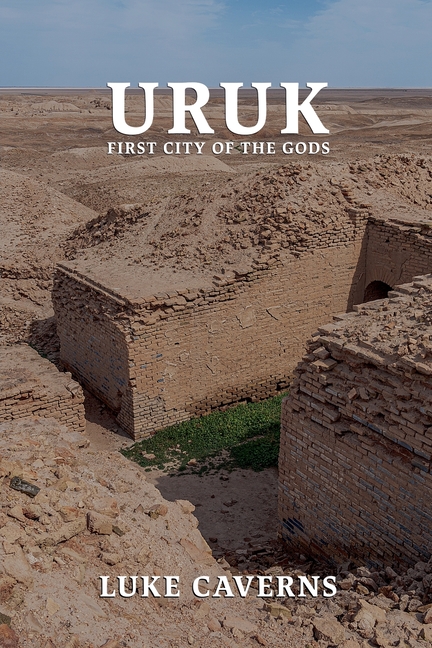
URUK, First City of the Gods - Paperback
Pay over time for orders over $35.00 with
Offers & Perks
Earn 24 points with this purchase
Added to your rewards balance after checkout.
100 points welcome bonus
Create an account and start with extra points.
Uruk stood on the southern Mesopotamian plain, built from mudbrick, river clay, labour, grain, ritual, and memory. Its ruins at Warka preserve one of the oldest great urban sites in the world: temple districts, administrative buildings, mass-produced bowls, sealings, proto-cuneiform tablets, and sacred architecture rebuilt over centuries. This book investigates the city behind the famous names: Inanna and her sanctuary at Eanna, Utu/Shamash and divine justice, the Sumerian King List, Enmerkar, Lugalbanda, Dumuzi, and Gilgamesh. These figures carried Uruk into myth, but the city beneath them was real: walls, temples, storehouses, workers, scribes, offerings, fields, flocks, and clay records.
The earliest writing from Uruk was not heroic poetry. It counted grain, labour, animals, beer, textiles, and obligations. The temple was not only a place of worship. It was the house of a god, an estate, a workplace, a storehouse, and a centre of authority. Kingship did not appear as a clean political office. It formed through ritual, divine favour, city memory, and the hard problem of organizing people at a scale earlier communities had not faced. Uruk became a city of gods because it was also a city of systems. This is a study of archaeology, myth, kingship, sacred space, and written memory: the mudbrick city beneath Gilgamesh, the cult world behind Inanna, and the old Mesopotamian attempt to explain power through temples, gods, rituals, lists, and stories.
Luke Caverns is an independent researcher, explorer, and former archaeology lecturer whose work bridges academic inquiry with field-based investigation. He began teaching archaeology in 2004, where he developed a reputation for bringing ancient civilizations to life through a combination of rigorous scholarship and a deep fascination with the mysteries of the past. From early in his career, Caverns was drawn beyond the traditional boundaries of the classroom. His interests expanded toward the great unanswered questions of human history-particularly the rise of the civilizations of the New World, the enduring enigmas of ancient Egypt, the monumental landscapes of Anatolia, and the global phenomenon of megalithic construction. These interests would eventually define his life's work.
Leaving formal academia behind, Caverns pursued a more immersive path, dedicating himself to both linguistic and field research. He undertook the study of Latin, Arabic, Spanish, and Quechua, equipping himself to engage directly with primary sources, regional histories, and local traditions across multiple cultural spheres. This linguistic foundation allowed him to move beyond translation and interpretation, opening a more direct connection to the civilizations he studies. His field experience includes participation in five archaeological excavations across South America, where he worked alongside researchers and local teams in environments ranging from high Andean plateaus to dense jungle terrain. These expeditions deepened his focus on pre-Columbian cultures, ancient trade networks, and the architectural achievements of early American civilizations.
Today, Caverns operates as a modern-day explorer, documenting and investigating little-known and often overlooked archaeological sites throughout Central America. His work combines on-site analysis, historical comparison, and a critical examination of both established and alternative interpretations of the ancient world. Blending the discipline of an academic with the curiosity of an explorer, Luke Caverns represents a new generation of independent researchers-one equally at home in ancient texts, remote landscapes, and the enduring mysteries of humanity's earliest civilizations.
Contributor(s)
Author
Free shipping on orders over $75. Standard shipping takes 3-7 business days. Eligible items may be returned within 30 days of delivery. Conditions apply.