
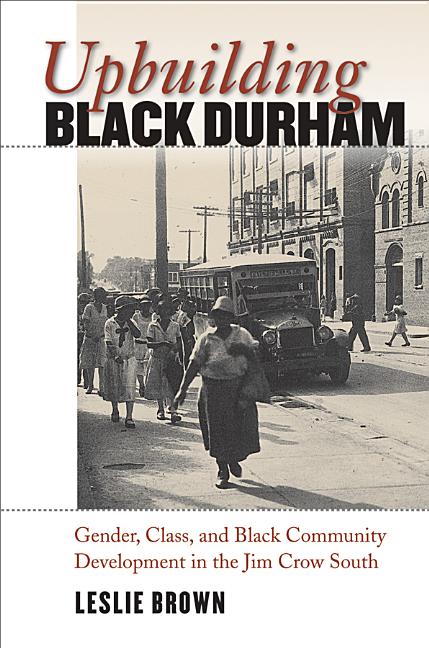
Upbuilding Black Durham: Gender, Class, and Black Community Development in the Jim Crow South - Paperback
by Leslie Brown
$44.99
Quantity
01
Pay over time for orders over $35.00 with
Offers & Perks
Earn 44 points with this purchase
Added to your rewards balance after checkout.
100 points welcome bonus
Create an account and start with extra points.
Availability:In StockContributor:Leslie BrownSeries:The John Hope Franklin African American History and CultureTheme:Chronological Period/1851-1899, Chronological Period/20th Century, Cultural Region/South Atlantic, Cultural Region/Southeast U.S., Ethnic Orientation/African American, Geographic Orientation/North Carolina, Interdisciplinary Studies/Gender/Sexuality Studies, Locality/Raleigh-Durham-Chapel Hill, NC, Sex & Gender/Feminine, Topical/Black HistoryPublish date:9/15/2008Pages:472
Languages:EnglishPublisher:University of North Carolina PressISBN-13:9780807858356ISBN-10:0807858358UPC:9780807858356Book Category:Social Science, HistoryBook Subcategory:Cultural & Ethnic Studies, United States, Women's StudiesBook Topic:African American & Black Studies, State & LocalSize:9.00 x 6.00 x 1.10 inchesWeight:0.658Product ID:SC22GGP7PK
In the 1910s, both W. E. B. Du Bois and Booker T. Washington praised the black community in Durham, North Carolina, for its exceptional race progress. Migration, urbanization, and industrialization had turned black Durham from a post-Civil War liberation community into the "capital of the black middle class." African Americans owned and operated mills, factories, churches, schools, and an array of retail services, shops, community organizations, and race institutions. Using interviews, narratives, and family stories, Leslie Brown animates the history of this remarkable city from emancipation to the civil rights era, as freedpeople and their descendants struggled among themselves and with whites to give meaning to black freedom.
Brown paints Durham in the Jim Crow era as a place of dynamic change where despite common aspirations, gender and class conflicts emerged. Placing African American women at the center of the story, Brown describes how black Durham's multiple constituencies experienced a range of social conditions. Shifting the historical perspective away from seeing solidarity as essential to effective struggle or viewing dissent as a measure of weakness, Brown demonstrates that friction among African Americans generated rather than depleted energy, sparking many activist initiatives on behalf of the black community.
Brown paints Durham in the Jim Crow era as a place of dynamic change where despite common aspirations, gender and class conflicts emerged. Placing African American women at the center of the story, Brown describes how black Durham's multiple constituencies experienced a range of social conditions. Shifting the historical perspective away from seeing solidarity as essential to effective struggle or viewing dissent as a measure of weakness, Brown demonstrates that friction among African Americans generated rather than depleted energy, sparking many activist initiatives on behalf of the black community.
Languages:EnglishPublisher:University of North Carolina PressISBN-13:9780807858356ISBN-10:0807858358UPC:9780807858356Book Category:Social Science, HistoryBook Subcategory:Cultural & Ethnic Studies, United States, Women's StudiesBook Topic:African American & Black Studies, State & LocalSize:9.00 x 6.00 x 1.10 inchesWeight:0.658Product ID:SC22GGP7PK
Leslie Brown (d. 2016) was assistant professor of history at Williams College.
Publisher: University of North Carolina Press
Contributor(s)
Author
Free shipping on orders over $75. Standard shipping takes 3-7 business days. Returns accepted within 30 days of purchase.