
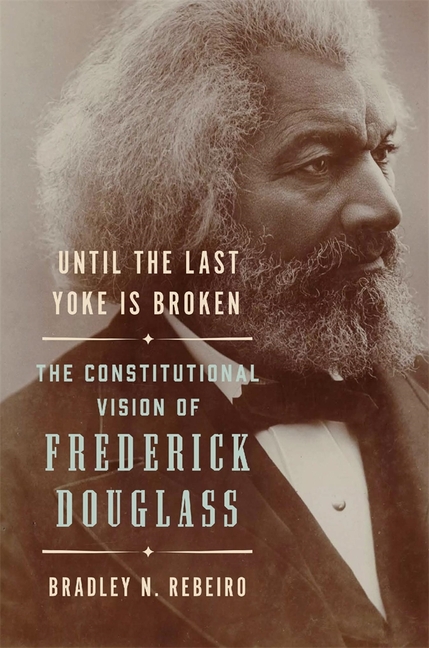
Until the Last Yoke Is Broken: The Constitutional Vision of Frederick Douglass - Hardcover
$21.99
$29.95
-27%Quantity
01
Pay over time for orders over $35.00 with
Offers & Perks
Earn 21 points with this purchase
Added to your rewards balance after checkout.
100 points welcome bonus
Create an account and start with extra points.
Availability:In StockContributor:Bradley N. RebeiroTheme:Chronological Period/19th Century, Ethnic Orientation/African AmericanPublish date:9/29/2026Pages:360
Languages:EnglishPublisher:Harvard University PressISBN-13:9780674301689ISBN-10:0674301684UPC:9780674301689Book Category:Law, HistoryBook Subcategory:Constitutional, United States, Legal HistoryBook Topic:19th CenturyWeight:0.667Product ID:SCBB61XES7
A groundbreaking analysis of Frederick Douglass as constitutional theorist, showing how his vision, which prefigured today's originalism, melded history and natural rights to address the evil of slavery.
In his celebrated address "What to the Slave is the Fourth of July?" Frederick Douglass denounced America's hypocritical celebration of freedom. But he did not blame the nation's founding document for enabling the evil of slavery. Rather, he proclaimed that "interpreted as it ought to be interpreted, the Constitution is a Glorious Liberty Document." This was no mere rhetorical flourish. Examining Douglass not just as an activist but as a legal and political theorist, Until the Last Yoke Is Broken reveals that his abolitionism was guided by rigorous constitutional interpretation. Reconstructing Douglass's method from his speeches and writings, Bradley Rebeiro shows that his approach both anticipated and challenged aspects of contemporary originalism. Like today's originalists, Douglass saw historical meaning as central to constitutional analysis. But unlike today's originalism, Douglass's goes beyond simply asking how the Constitution was understood at its ratification. Instead, Douglass insisted that whenever a constitutional provision is ambiguous, the interpreter must adopt whatever meaning best agrees with the natural rights affirmed in the Declaration of Independence. Rebeiro also shows how Douglass balanced this constitutional vision with pragmatism during Reconstruction. When political tensions pitted the fate of black suffrage against women's suffrage, Douglass set aside the theoretically pure for the politically possible; as soon as black suffrage was secured, he returned to advocating for universal voting rights. "It was mine to stand for the freedom of people of all colors," Douglass wrote near the end of his life, "until in our land the last yoke was broken and the last bondsman was set free."Languages:EnglishPublisher:Harvard University PressISBN-13:9780674301689ISBN-10:0674301684UPC:9780674301689Book Category:Law, HistoryBook Subcategory:Constitutional, United States, Legal HistoryBook Topic:19th CenturyWeight:0.667Product ID:SCBB61XES7
Rebeiro, Bradley N.: - Bradley N. Rebeiro is a legal scholar whose research spans constitutional law, political theory, and antislavery legal thought. He is an associate professor at BYU Law School and a research fellow at the Georgetown Center for the Constitution.
Publisher: Harvard University Press
Contributor(s)
Author
Free shipping on orders over $75. Standard shipping takes 3-7 business days. Eligible items may be returned within 30 days of delivery. Conditions apply.