
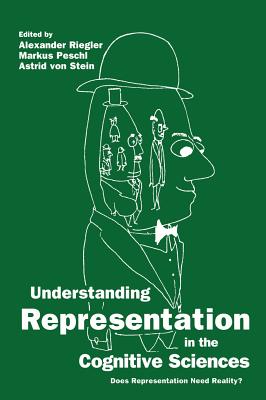
Understanding Representation in the Cognitive Sciences: Does Representation Need Reality? - Hardcover
$168.99
$169.99
-1%Quantity
01
Pay over time for orders over $35.00 with
Offers & Perks
Earn 168 points with this purchase
Added to your rewards balance after checkout.
100 points welcome bonus
Create an account and start with extra points.
Availability:In StockContributor:Alexander Riegler, Markus Peschl, Astrid von SteinPublish date:1/31/2000Pages:304
Languages:EnglishPublisher:SpringerISBN-13:9780306462863ISBN-10:0306462869UPC:9780306462863Book Category:Psychology, Medical, PhilosophyBook Subcategory:Cognitive Psychology & Cognition, Neurology, Ethics & Moral PhilosophySize:10.00 x 7.00 x 0.75 inchesWeight:0.776Product ID:SCQ2SS0ZRP
urrently a paradigm shift is occurring in for the conventional understanding of represen- which the traditional view of the brain as tions. The paper also summarizes the rationale for C representing the "things of the world" is the selection of contributions to this volume, which challenged in several respects. The present volume will roughly proceed from relatively "realist" c- is placed at the edge of this transition. Based on the ceptions of representation to more "constructivist" 1997 conference "New Trends in Cognitive Sci- interpretations. The final chapter of discussions, ence" in Vienna, Austria, it tries to collect and in- taped during and at the end of the conference, p- grate evidence from various disciplines such as p- vides the reader with the possibility to reflect upon losophy of science, neuroscience, computational the different approaches and thus contributes to b- approaches, psychology, semiotics, evolutionary ter and more integrative understanding of their biology, social psychology etc., to foster a new thoughts and ideas. understanding of representation. The subjective experience of an outside world This book has a truly interdisciplinary character. It seems to suggest a mapping process where environ- is presented in a form that is readily accessible to mental entities are projected into our mind via some professionals and students alike across the cognitive kind of transmission. While a profound critique of sciences such as neuroscience, computer science, this idea is nearly as old as philosophy, it has gained philosophy, psychology, and sociology.
Languages:EnglishPublisher:SpringerISBN-13:9780306462863ISBN-10:0306462869UPC:9780306462863Book Category:Psychology, Medical, PhilosophyBook Subcategory:Cognitive Psychology & Cognition, Neurology, Ethics & Moral PhilosophySize:10.00 x 7.00 x 0.75 inchesWeight:0.776Product ID:SCQ2SS0ZRP
Publisher: Springer
Edition
1999 Edition
Contributor(s)
Free shipping on orders over $75. Standard shipping takes 3-7 business days. Eligible items may be returned within 30 days of delivery. Conditions apply.