
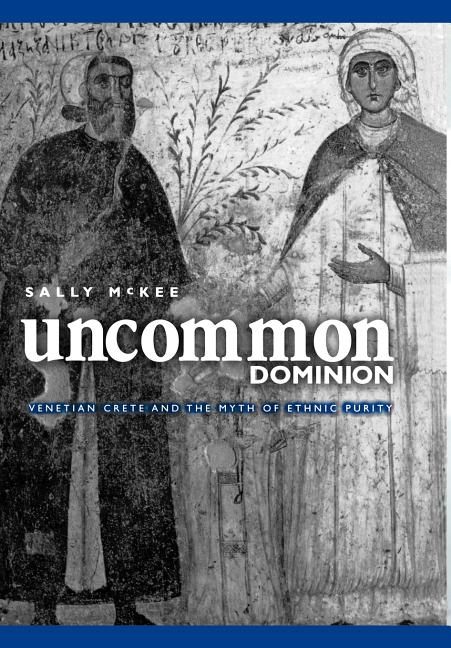
Uncommon Dominion: Venetian Crete and the Myth of Ethnic Purity - Hardcover
by Sally McKee
$58.99
$59.95
-2%Quantity
01
Pay over time for orders over $35.00 with
Offers & Perks
Earn 58 points with this purchase
Added to your rewards balance after checkout.
100 points welcome bonus
Create an account and start with extra points.
Availability:In StockContributor:Sally McKeeSeries:Middle AgesTheme:Chronological Period/Medieval (500-1453) Studies, Cultural Region/GreecePublish date:9/20/2000Pages:288
Languages:EnglishPublisher:University of Pennsylvania PressISBN-13:9780812235623ISBN-10:0812235622UPC:9780812235623Book Category:History, Social ScienceBook Subcategory:Europe, AnthropologyBook Topic:Medieval, Cultural & Social, GreeceSize:9.10 x 6.30 x 1.10 inchesWeight:0.613Product ID:SCFT9DT1KW
From 1211 until its loss to the Ottomans in 1669, the Greek island we know as Crete was the Venetian colony of Candia. Ruled by a paid civil service fully accountable to the Venetian Senate, Candia was distinct from nearly every other colony of the medieval period for the unprecedented degree to which the colonial power was involved in its governance.
Yet, for Sally McKee, the importance of the Cretan colony only begins with the anomalous manner of the Venetian state's rule. Uncommon Dominion tells the story of Venetian Crete, the home of two recognizably distinct ethnic communities, the Latins and the Greeks. The application of Venetian law to the colony made it possible for the colonial power to create and maintain a fiction of ethnic distinctness. The Greeks were subordinate to the Latins economically, politically, and juridically, yet within a century of Venetian colonization, the ethnic differences between Latin and Greek Cretans in daily material life were significantly blurred. Members of the groups intermarried, many of them learned each other's language, and some even chose to worship by the rites of the other's church. Holding up ample evidence of acculturation and miscegenation by the colony's inhabitants, McKee uncovers the colonial forces that promoted the persistence of ethnic labeling despite the lack of any clear demarcation between the two predominant communities. As McKee argues, the concept of ethnic identity was largely determined by gender, religion, and social status, especially by the Latin and Greek elites in their complex and frequently antagonistic social relationships. Drawing expertly from notarial and court records, as well as legislative and literary sources, Uncommon Dominion offers a unique study of ethnicity in the medieval and early modern periods. Students and scholars in medieval, colonial, and postcolonial studies will find much of use in studying this remarkable colonial experiment.Languages:EnglishPublisher:University of Pennsylvania PressISBN-13:9780812235623ISBN-10:0812235622UPC:9780812235623Book Category:History, Social ScienceBook Subcategory:Europe, AnthropologyBook Topic:Medieval, Cultural & Social, GreeceSize:9.10 x 6.30 x 1.10 inchesWeight:0.613Product ID:SCFT9DT1KW
Sally McKee is Associate Professor of History at the University of California, Davis.
Publisher: University of Pennsylvania Press
Contributor(s)
Author
Free shipping on orders over $75. Standard shipping takes 3-7 business days. Returns accepted within 30 days of purchase.