
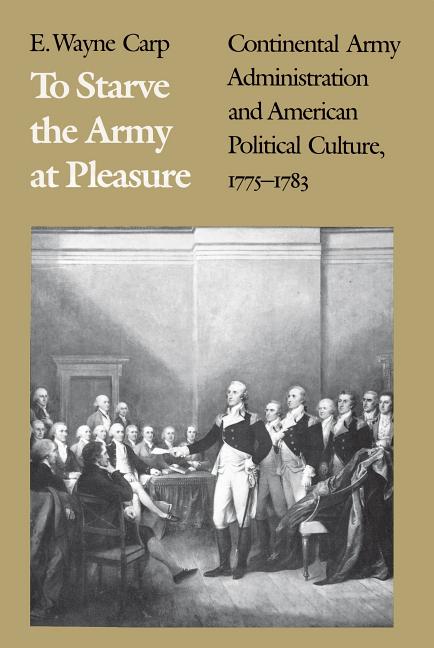
To Starve the Army at Pleasure: Continental Army Administration and American Political Culture, 1775-1793 - Paperback
Pay over time for orders over $35.00 with
Offers & Perks
Earn 47 points with this purchase
Added to your rewards balance after checkout.
100 points welcome bonus
Create an account and start with extra points.
American political culture and military necessity were at odds during the War for American Independence, as demonstrated in this interpretation of Continental army administration. E. Wayne Carp shows that at every level of authority -- congressional, state, and county -- a localistic world-view, a deferential political order, and adherence to republican ideology impeded the task of supplying the army, even though independence demanded military strength.
Placing military history within the context of colonial and revolutionary historiography, Carp finds that the colonial American belief that authority and political power should be decentralized deeply influenced Congress's approach to the task of supplying the army. Furthermore, most Congressmen had neither military experience nor any idea of how to administer an army, while local governments constantly thwarted the army's efforts to obtain supplies -- they blocked impressment and interfered with the movement of food and clothing.
Carp shows that political leaders eventually adjusted their ideals to the imperatives of winning the war. He offers a revisionist analysis of the origins of the Nationalist movement of 1780-83 that was begun by army officers and state legislators fearing the imminent failure of the Revolution. Lacking unity and blinded by republican ideology, the Nationalists did not markedly improve the administration of the army. Instead, it was largely through the efforts of Superintendent of Finance Robert Morris, the cooperation of the French, and sheer luck that the British were ultimately defeated. Carp concludes that the Americans won the Revolution "in spite of, rather than because of, their political beliefs."
Free shipping on orders over $75. Standard shipping takes 3-7 business days. Eligible items may be returned within 30 days of delivery. Conditions apply.