
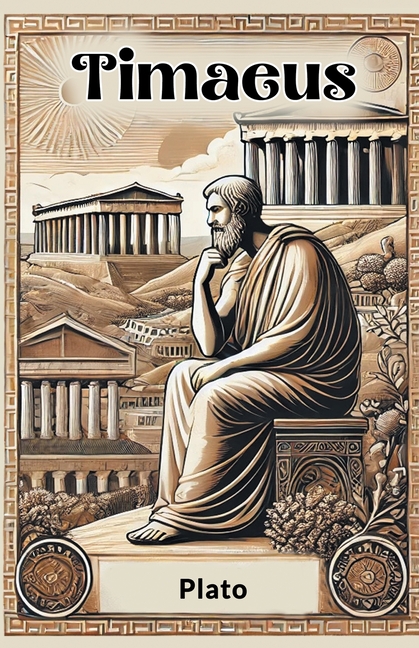
Timaeus - Paperback
by Plato
$12.99
$16.99
-24%Choose Option


Quantity
01
Pay over time for orders over $35.00 with
Offers & Perks
Earn 12 points with this purchase
Added to your rewards balance after checkout.
100 points welcome bonus
Create an account and start with extra points.
Languages:EnglishPublisher:Double 9 BooksISBN-13:9789365787368ISBN-10:936578736XUPC:9789365787368Book Category:Philosophy, ReligionBook Subcategory:Metaphysics, TheologySize:8.50 x 5.50 x 0.35 inchesWeight:0.182Product ID:SC1EPWBXZQ
"Timaeus" by Plato is a foundational philosophical dialogue that delves into cosmology and the creation of the universe. In this work, Plato explores the origins of the cosmos through the lens of ideal forms and divine intelligence. The dialogue is presented as a rational explanation of the universe's formation, providing insights into Plato's metaphysical and theological concepts. Central to the text is the character of Timaeus, who offers a detailed account of the universe's creation by a divine craftsman, using the principles of theoretical science and ideal forms. Plato's discourse in "Timaeus" reflects his broader philosophical framework, addressing questions about the nature of reality and the rational structure of the cosmos. As part of Plato's broader body of work, including dialogues like "The Republic," this text is crucial for understanding his views on the relationship between the divine and the physical world. "Timaeus" remains a key text in ancient Greek philosophy and the study of cosmology.
Languages:EnglishPublisher:Double 9 BooksISBN-13:9789365787368ISBN-10:936578736XUPC:9789365787368Book Category:Philosophy, ReligionBook Subcategory:Metaphysics, TheologySize:8.50 x 5.50 x 0.35 inchesWeight:0.182Product ID:SC1EPWBXZQ
Plato: - During the Classical era of ancient Greece, the philosopher Plato was born in Athens. He established the Academy, the first university on the European continent, as well as the Platonist school of philosophy. His interpretation of Plotinus had a significant impact on both Islam and Christianity. His theory of Forms, sometimes known as Platonism, is his most well-known contribution. He is also the inspiration for the Platonic solids and Platonic love. Plato was one of the most important figures in the ancient world, and his body of work is said to have persisted unaltered for more than 2,400 years. Even though little of his predecessors' writings have survived, it is believed that he had a significant impact on the works of Socrates, Heraclitus, Pythagoras, and Parmenides. On a tract of land in the Grove of Hecademus or Academus, a mythical Attic figure, Plato built it. The Academy remained in operation until Lucius Cornelius Sulla demolished it in 84 BC. Seneca claims that Plato passed away on the day of his birth at the age of 81. The Suda reports that he lived to be 82 years old, but Neanthes states that he was 84 years old. Tertullian said that Plato merely passed away while sleeping. By will, Plato bequeathed his Iphistiadae land to a younger relative.
Publisher: Double 9 Books
Free shipping on orders over $75. Standard shipping takes 3-7 business days. Returns accepted within 30 days of purchase.