
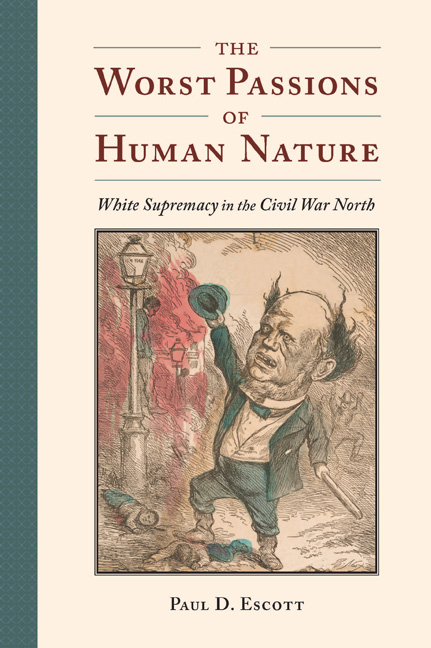
The Worst Passions of Human Nature: White Supremacy in the Civil War North - Hardcover
Pay over time for orders over $35.00 with
Offers & Perks
Earn 21 points with this purchase
Added to your rewards balance after checkout.
100 points welcome bonus
Create an account and start with extra points.
The American North's commitment to preventing a southern secession rooted in slaveholding suggests a society united in its opposition to slavery and racial inequality. The reality, however, was far more complex and troubling. In his latest book, Paul Escott lays bare the contrast between progress on emancipation and the persistence of white supremacy in the Civil War North. Escott analyzes northern politics, as well as the racial attitudes revealed in the era's literature, to expose the nearly ubiquitous racism that flourished in all of American society and culture.
Contradicting much recent scholarship, Escott argues that the North's Democratic Party was consciously and avowedly "the white man's party," as an extensive examination of Democratic newspapers, as well as congressional debates and other speeches by Democratic leaders, proves. The Republican Party, meanwhile, defended emancipation as a war measure but did little to attack racism or fight for equal rights. Most Republicans propagated a message that emancipation would not disturb northern race relations or the interests of northern white voters: freed slaves, it was felt, would either leave the nation or remain in the South as subordinate laborers.
Escott's book uncovers the substantial and destructive racism that lay beyond the South's borders. Although emancipation represented enormous progress, racism flourished in the North, and assumptions of white supremacy remained powerful and nearly ubiquitous throughout America.
Paul D. Escott is Reynolds Professor of History Emeritus at Wake Forest University and author of Slavery Remembered: A Record of Twentieth-Century Slave Narratives, winner of the Mayflower Cup, and Lincoln's Dilemma: Blair, Sumner, and the Republican Struggle over Racism and Equality in the Civil War Era (Virginia).
Contributor(s)
Author
Free shipping on orders over $75. Standard shipping takes 3-7 business days. Eligible items may be returned within 30 days of delivery. Conditions apply.