
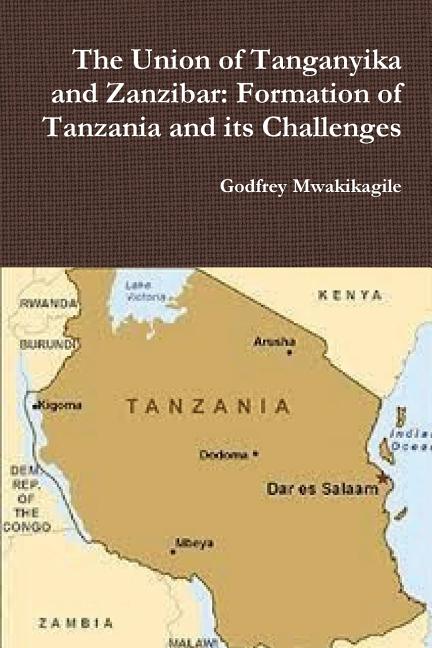
The Union of Tanganyika and Zanzibar: Formation of Tanzania and its Challenges - Paperback
$12.99
$14.95
-13%Quantity
01
Pay over time for orders over $35.00 with
Offers & Perks
Earn 12 points with this purchase
Added to your rewards balance after checkout.
100 points welcome bonus
Create an account and start with extra points.
Availability:In StockContributor:Godfrey MwakikagileTheme:Cultural Region/African, Cultural Region/East Africa, Ethnic Orientation/African AmericanPublish date:7/30/2016Pages:326
Languages:EnglishPublisher:New Africa PressISBN-13:9789987160464ISBN-10:9987160468UPC:9789987160464Book Category:History, Social ScienceBook Subcategory:Africa, Cultural & Ethnic StudiesBook Topic:East, African American & Black StudiesSize:9.02 x 5.98 x 0.68 inchesWeight:0.436Product ID:SCRENHZPT6
The author looks at how the union of Tanganyika and Zanzibar was formed to create the new nation of Tanzania. He contends that Anglo-American geopolitical interests in the context of the Cold War were not the driving force behind the merger but the initiatives taken by the leaders of Tanganyika and Zanzibar to unite their countries. He also states that the leaders who played the biggest role in forming the union were President Julius Nyerere of Tanganyika, Tanganyika's minister of foreign affairs, Oscar Kambona; President Abeid Karume of Zanzibar, and Zanzibar's vice president Abdallah Kassim Hanga - but especially Nyerere and Kambona because of the decisions they made and implemented to lay the foundation and facilitate the merger. He cites various sources to document his study. The work is a counter-thesis to the argument that the leaders of the United States and Britain, including their diplomats in the two East African countries, conceived and facilitated formation of the union to protect Western interests in the region. It is argued that they did so in order to neutralise communist influence in Zanzibar because the island nation was in danger of becoming a communist satellite controlled by the Soviets or the Chinese if it came under the leadership of Zanzibar's minister of foreign affairs, Abdulrahman Mohamed Babu, who was considered to be pro-Chinese, or Kassim Hanga who was considered to be pro-Soviet. That would have provided a base for the Soviets or the Chinese and their allies to spread communism and undermine Western interests in the region and in Africa as a whole if indeed, as it was feared by the West, Zanzibar became "the Cuba of Africa." The author also looks at the challenges the union faced when it was being formed and the other challenges it has faced and continues to face since then. The work is an updated version of the author's previous books on the formation of Tanzania, the first and only union of independent states ever formed on the continent since the end of colonial rule.
Languages:EnglishPublisher:New Africa PressISBN-13:9789987160464ISBN-10:9987160468UPC:9789987160464Book Category:History, Social ScienceBook Subcategory:Africa, Cultural & Ethnic StudiesBook Topic:East, African American & Black StudiesSize:9.02 x 5.98 x 0.68 inchesWeight:0.436Product ID:SCRENHZPT6
Free shipping on orders over $75. Standard shipping takes 3-7 business days. Eligible items may be returned within 30 days of delivery. Conditions apply.