
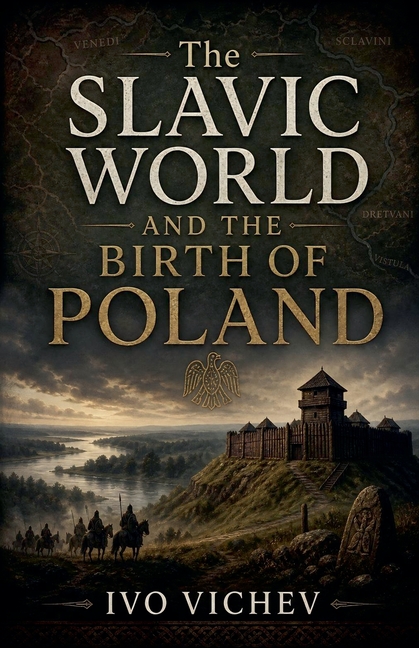
The Slavic World and the Birth of Poland - Paperback
Pay over time for orders over $35.00 with
Offers & Perks
Earn 30 points with this purchase
Added to your rewards balance after checkout.
100 points welcome bonus
Create an account and start with extra points.
Before Poland had a name, the land already held rivers, forests, strongholds, tribes, trade routes, sacred mountains, and older memories buried in the soil.
The Slavic World and the Birth of Poland traces the long road from the early Slavic world to the rise of the first recognisable Polish state under the Piast dynasty. It begins before kings, borders, chronicles, or national memory, in the physical world that made early Poland possible: the North European Plain, the Vistula and Oder river systems, the Baltic coast, the Carpathian gates, deep forests, marshes, lake districts, and soils that could feed communities strong enough to build power.
Ivo Vichev follows the story from archaeology to state formation. The book moves through the older prehistoric and Roman-period cultures of the Polish lands, including Biskupin, the Lusatian world, the Przeworsk and Wielbark cultures, and the difficult silence left by peoples who built, traded, fought, farmed, and vanished without leaving their own written histories. It then turns to the Proto-Slavic homeland, the great Slavic expansion, and the arrival of Slavic-speaking communities in the Vistula and Oder basins.
This is not a simple origin myth. The early Polish world was not born whole. It was a patchwork of tribes, strongholds, routes, rival centres, sacred places, and competing futures. The Polans of Greater Poland were only one part of that world. Around them stood the Vistulans of Cracow and the upper Vistula, the Goplans around Lake Goplo, the Silesian Slavs around Mount Ślęża and the Oder basin, the Pomeranians on the Baltic coast, the Mazovians in the forests and frontiers of the east, and smaller groups whose names survive only in scattered foreign records.
The book explores how geography shaped power, but did not decide it. Rich soils could feed warriors. Rivers could carry trade or invasion. Forests could shelter freedom and delay authority. Strongholds could protect communities or become instruments of coercion. Sacred mountains, pagan cults, assemblies, local communities, warrior retinues, captives, silver, salt, amber, and grain all belonged to the hard machinery from which early rule emerged.
At the centre of the story is the rise of the Piasts. Their power did not appear from legend alone. It was built in timber, earth, tribute, violence, alliance, and calculation. Strongholds at Gniezno, Poznań, Giecz, Lednica Island, Grzybowo, and other centres formed the network through which local authority became territorial rule. Older rivals were absorbed, defeated, or rewritten into memory. The name of one tribal group expanded until it became the name of a state.
The Slavic World and the Birth of Poland also follows the crucial southern and western pressures that shaped the new realm: Great Moravia, Bohemia, the Saxon frontier, the Veleti, the Wolinians, the Baltic world, and the Latin Christian order pressing eastward. Mieszko I did not accept baptism in 966 as an isolated act of piety or a neat civilisational slogan. He made a political and spiritual decision inside a dangerous frontier world, taking Christianity on his own terms before it could be used against him.
The final chapters follow Mieszko from war and alliance to baptism, succession, papal protection, and the damaged document known as the Dagome Iudex. The result is not a romantic tale of inevitable nationhood, but a serious narrative of survival and formation: how a pagan stronghold realm became visible to popes, emperors, bishops, merchants, enemies, and chroniclers.
Written for readers who want serious history without academic deadness, this book brings together archaeology, geography, source criticism, political power, pagan belief, trade, warfare, and dynastic ambition. It treats Poland's beginning not as a legend to repeat, but as a world to reconstruct from broken evidence.
Poland was not discovered. It was made.
I was born in Varna, Bulgaria, on the edge of the Black Sea - a place where history is never really "past". Growing up between old empires and new borders, I was surrounded by stories of wars, occupations, disappearances and sudden changes of flag.
Later I moved to Warsaw, Poland, where I studied history and public relations at the Polish Academy of Sciences (PAN). Warsaw is a city built on ruins and memories, and it forced me to ask one question over and over again:
Why is so much of our most important history told in the most boring way possible?
From dry facts to living storiesLike every history student, I spent endless hours buried in heavy academic books - dates, treaties, footnotes stacked on footnotes. I respected the work, but I often felt like the life had been drained out of the events themselves.
That changed when I discovered Ryszard Kapuściński. His books had that rare tone I'd been searching for: history and politics told through people, scenes and atmosphere. It was factual, but it breathed.
From that moment I knew what I wanted to do: take serious history and tell it with the clarity and tension of a documentary - so future generations don't have to suffer through dead, lifeless books to understand the past.
What I write aboutMy books focus on the places where power is most visible - and most hidden:
- Wars and battles
- Espionage and cyber conflict
- Country histories
Some books are big, sweeping national histories. Others zoom in on a single battle, uprising or covert operation. All of them try to answer the same question: What really happened here, and what does it mean for the people who had to live through it?
How I tell historyIf you read my books, you can expect narrative, scene-by-scene storytelling - not just lists of dates. Serious research from archives, memoirs, official reports and investigative journalism. Clear explanations of complex events like cyberattacks and proxy wars. And a refusal to simplify messy, uncomfortable truths.
I don't write official history. I don't write propaganda. I write stories that are honest, human and readable - the kind of books I was always looking for as a student and rarely found.
If you care about how we got from trenches and partitions to cyberwar and drone strikes - and you don't want to fall asleep over another textbook - I wrote these books for you.
"Contributor(s)
Author
Free shipping on orders over $75. Standard shipping takes 3-7 business days. Eligible items may be returned within 30 days of delivery. Conditions apply.