
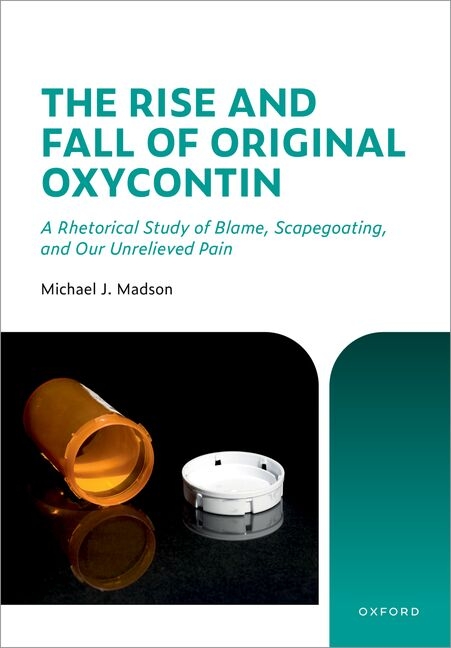
The Rise and Fall of Original Oxycontin: A Rhetorical Study of Blame, Scapegoating, and Our Unrelieved Pain - Hardcover
$109.99
Quantity
01
Pay over time for orders over $35.00 with
Offers & Perks
Earn 109 points with this purchase
Added to your rewards balance after checkout.
100 points welcome bonus
Create an account and start with extra points.
Languages:EnglishPublisher:Oxford University PressISBN-13:9780197835265ISBN-10:0197835260UPC:9780197835265Book Category:Social ScienceBook Subcategory:Disease & Health Issues, Anthropology, SociologyBook Topic:Cultural & Social, Social TheorySize:9.50 x 6.51 x 0.83 inchesWeight:0.518Product ID:SC5NYW0GV1
The United States opioid crisis has wrought devastation on a massive scale. With closure elusive, much of the blame has fallen on a single pill, a long-acting oxycodone tablet called OxyContin. Perhaps one of the most notorious prescription painkillers on the market, OxyContin may be the best documented opioid in the country due to extensive litigation, regulation, and news coverage. Analyses of these documents can provide deeper insights into the drug's lifecycle as well as the shaping of public understandings of the crisis. Blame pervades our lived experiences, affecting how we norm and punish, explain and evade, reconcile and heal. This phenomenon has rarely been discussed by scholars, leaving gaps in our collective knowledge. Drawing on extensive documentation--from media coverage and court records to internal company emails--Madson examines who was blamed, how, and why. To do this, he has adapted for a new critical contextualized methodology to identify key players, map time-space axes, and pinpoint tipping points. Rather than pointing to a single cause, The Rise and Fall of Original OxyContin traces how blame shifted among drug makers, regulators, doctors, patients, and others over time, leaving some as scapegoats. Using clear, accessible language, it offers insight into how blame can influence public health, policy, and trust. The outcome is a preliminary model of blame discourse in pharmaceutical contexts, which aims to inform future research. Applications can be drawn to three critical areas of practice: pharmaceutical risk communication, organizational health literacy, and interprofessional education. The work provides valuable insights into the origins of miscommunication about risk, addiction, and corporate responsibility, and offers practical takeaways for future crisis communication and risk regulation.
Languages:EnglishPublisher:Oxford University PressISBN-13:9780197835265ISBN-10:0197835260UPC:9780197835265Book Category:Social ScienceBook Subcategory:Disease & Health Issues, Anthropology, SociologyBook Topic:Cultural & Social, Social TheorySize:9.50 x 6.51 x 0.83 inchesWeight:0.518Product ID:SC5NYW0GV1
Michael J. Madson is an Assistant Professor at Arizone State University, where he teaches on technical communication and user experience. He is also an Adjunct Associate Professor at the Medical University of South Carolina. His research interests include how communication impacts health and wellness, focusing primarily on drugs. He is the founding organizer of the Conference on Teaching Writing in the Health Professions (WIHPcon) and has served as a consultant for the Icahn School of Medicine at Mount Sinai. In 2016, he earned his doctorate in rhetoric and scientific and technical communication from the University of Minnesota-Twin Cities.
Publisher: Oxford University Press
Contributor(s)
Author
Free shipping on orders over $75. Standard shipping takes 3-7 business days. Eligible items may be returned within 30 days of delivery. Conditions apply.