
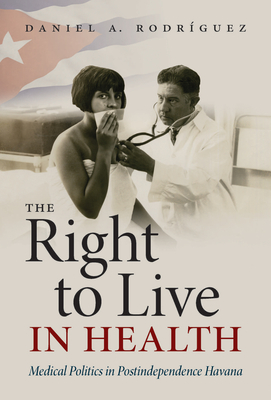
The Right to Live in Health: Medical Politics in Postindependence Havana - Hardcover
$115.99
Choose Option
Hardcover
$115.99
$105.00

Paperback
$40.99
Quantity
01
Pay over time for orders over $35.00 with
Offers & Perks
Earn 115 points with this purchase
Added to your rewards balance after checkout.
100 points welcome bonus
Create an account and start with extra points.
Languages:EnglishPublisher:University of North Carolina PressISBN-13:9781469659725ISBN-10:1469659727UPC:9781469659725Book Category:Social Science, Medical, HistoryBook Subcategory:Cultural & Ethnic Studies, Health Policy, Caribbean & West IndiesBook Topic:CubaSize:9.21 x 6.14 x 0.81 inchesWeight:0.622Product ID:SCGRSR0JYM
Daniel A. Rodríguez's history of a newly independent Cuba shaking off the U.S. occupation focuses on the intersection of public health and politics in Havana. While medical policies were often used to further American colonial power, in Cuba, Rodríguez argues, they evolved into important expressions of anticolonial nationalism as Cuba struggled to establish itself as a modern state. A younger generation of Cuban medical reformers, including physicians, patients, and officials, imagined disease as a kind of remnant of colonial rule. These new medical nationalists, as Rodríguez calls them, looked to medical science to guide Cuba toward what they envisioned as a healthy and independent future.
Rodríguez describes how medicine and new public health projects infused republican Cuba's statecraft, powerfully shaping the lives of Havana's residents. He underscores how various stakeholders, including women and people of color, demanded robust government investment in quality medical care for all Cubans, a central national value that continues today. On a broader level, Rodríguez proposes that Latin America, at least as much as the United States and Europe, was an engine for the articulation of citizens' rights, including the right to health care, in the twentieth century.
Rodríguez describes how medicine and new public health projects infused republican Cuba's statecraft, powerfully shaping the lives of Havana's residents. He underscores how various stakeholders, including women and people of color, demanded robust government investment in quality medical care for all Cubans, a central national value that continues today. On a broader level, Rodríguez proposes that Latin America, at least as much as the United States and Europe, was an engine for the articulation of citizens' rights, including the right to health care, in the twentieth century.
Languages:EnglishPublisher:University of North Carolina PressISBN-13:9781469659725ISBN-10:1469659727UPC:9781469659725Book Category:Social Science, Medical, HistoryBook Subcategory:Cultural & Ethnic Studies, Health Policy, Caribbean & West IndiesBook Topic:CubaSize:9.21 x 6.14 x 0.81 inchesWeight:0.622Product ID:SCGRSR0JYM
Daniel A. Rodríguez is assistant professor of history at Brown University.
Publisher: University of North Carolina Press
Author
Free shipping on orders over $75. Standard shipping takes 3-7 business days. Eligible items may be returned within 30 days of delivery. Conditions apply.