
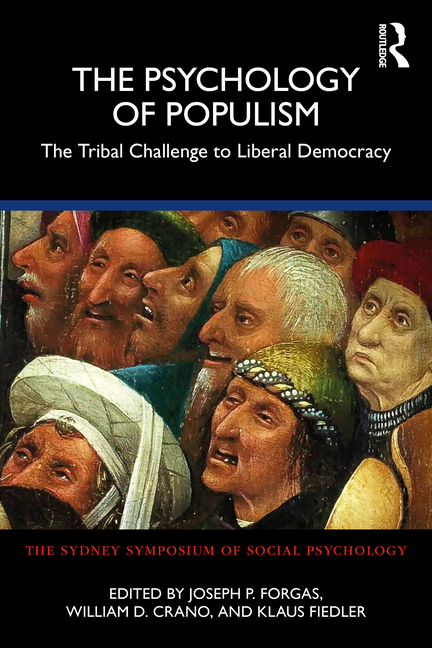
The Psychology of Populism: The Tribal Challenge to Liberal Democracy - Paperback
Choose Option
Paperback

Hardcover
Pay over time for orders over $35.00 with
Offers & Perks
Earn 69 points with this purchase
Added to your rewards balance after checkout.
100 points welcome bonus
Create an account and start with extra points.
The recent rise of populist politics represent a major challenge for liberal democracies. This important book explores the psychological reasons for the rise of populism, featuring contributions from leading international researchers in the fields of psychology and political science.
Unlike liberal democracy based on the Enlightenment values of individual freedom, autonomy and rationality, both right-wing and left-wing populism offer collectivist, autocratic formulations reminiscent of the evolutionary history and tribal instincts of our species. The book offers a comprehensive overview of the psychology of populism, covering such phenomena as identity seeking, anger and fear, collective narcissism, grievance, norms, perceptions of powerlessness and deprivation, authoritarianism, nationalism, radicalism, propaganda and persuasion, ethnocentrism, xenophobia and the effects of globalization.
The book is divided into four parts. Part I deals with the motivational and emotional factors that attract voters to populist causes, and the human needs and values that populist movements satisfy. Part II analyzes the cognitive features of populist appeals, especially their emphasis on simplicity, epistemic certainty and moral absolutism. Part III turns to one of the defining features of populism: its offer of a powerful tribal identity and collectivist ideology that provide meaning and personal significance to its followers. Finally, in Part IV, the propaganda tactics used by populist movements are analysed, including the role of charismatic leadership, authoritarianism, and nationalism and the use of conspiracy narratives and persuasive strategies.
This is fascinating reading on a highly topical issue. The book will be of interest to students, researchers, and applied professionals in all areas of psychology and the social sciences as a textbook or reference book, and to anyone interested in the global rise of populism.
Please follow this link for an insightful interview by one of the editors of the book - Joseph P. Forgas: https: //www.routledge.com/blog/article/editor-interview-the-psychology-of-populism
We have also created a short promotional video for the book here - https: //www.youtube.com/watch?v=iK1BEF8WyMA.
Joseph P. Forgas is Scientia Professor at the University of New South Wales. His research focuses on affective influences on social cognition and behavior. For his work, he received the Order of Australia and the Distinguished Scientific Contribution Award, and he has been elected Fellow of the Australian and Hungarian Academies of Science.
William D. Crano is Oskamp professor of Psychology at Claremont Graduate University. He was Liaison Scientist for the US Office of Naval Research, NATO Senior Scientist, and Fulbright Senior Scholar. His research focuses on attitude development and attitude change and their applications.
Klaus Fiedler is Professor of Psychology at the University of Heidelberg and Fellow of the German Academies of Science, the Association for Psychological Sciences, and Society for Personality and Social Psychology. His research focuses on social cognition, language, judgments, and decision making. He received several awards, including the Leibniz Award, and he is on the editorial boards of leading journals.
Contributor(s)
Free shipping on orders over $75. Standard shipping takes 3-7 business days. Eligible items may be returned within 30 days of delivery. Conditions apply.