
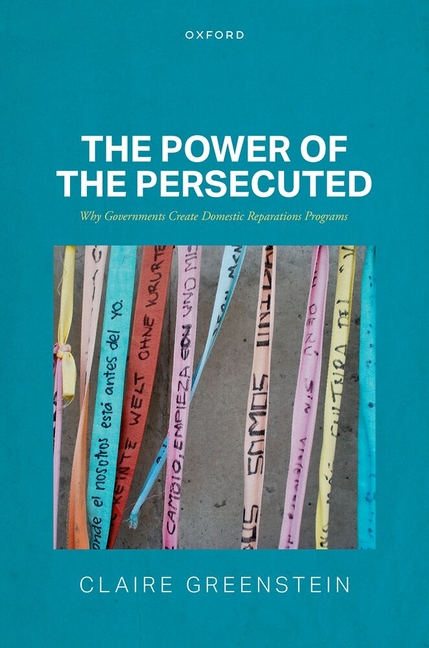
The Power of the Persecuted: Why Governments Create Domestic Reparations Programs - Hardcover
$41.99
Quantity
01
Pay over time for orders over $35.00 with
Offers & Perks
Earn 41 points with this purchase
Added to your rewards balance after checkout.
100 points welcome bonus
Create an account and start with extra points.
Languages:EnglishPublisher:Oxford University PressISBN-13:9780197849705ISBN-10:0197849709UPC:9780197849705Book Category:Political Science, Social Science, LawBook Subcategory:Human Rights, Activism & Social Justice, InternationalSize:9.32 x 6.61 x 0.68 inchesWeight:0.454Product ID:SC7WX8M6F6
Why would a state voluntarily pay reparations to citizens against whom it has committed human rights abuses when those citizens were recently so reviled, so powerless, that the state was able to abuse them without restraint? The very fact that domestic reparations programs exist is a puzzle. Despite the fact that it takes a great deal of political will to draft, pass, and implement a reparations program, dozens of them are currently being administered all around the world. The aim of The Power of the Persecuted is to solve that puzzle by answering a fundamental question: After governments commit severe human rights abuses against their own citizens, what motivates these governments (or their successors) to promise and pay reparations for their crimes? This book theorizes that, in keeping with the political process model developed by the social movement literature, domestic reparations programs are the result of victim group mobilization. The Power of the Persecuted offers the first cross-national, systematic test of this theory's applicability to reparations by applying it to three case studies: The West German government's reparations decisions regarding Jewish Germans affected by the Holocaust, the West German government's reparations decisions regarding reparations for Romani Germans persecuted by the Nazis, and the Peruvian government's reparations decisions regarding Peruvians harmed by the country's 1980-2000 Armed Internal Conflict. Using the political process model, original interview data from five countries, and archival sources, these detailed case studies show that when victims' groups mobilize and pressure a formerly abusive state for reparations, those reparations will be forthcoming in most non-autocracies. Conversely, when victims do not organize and demand reparations, reparations will almost certainly not be paid. The Power of the Persecuted demonstrates that the absence, creation, and timing of the case studies' domestic reparations programs are best explained not by economic considerations or international pressure, but rather by the lobbying efforts of organized victims' groups.
Languages:EnglishPublisher:Oxford University PressISBN-13:9780197849705ISBN-10:0197849709UPC:9780197849705Book Category:Political Science, Social Science, LawBook Subcategory:Human Rights, Activism & Social Justice, InternationalSize:9.32 x 6.61 x 0.68 inchesWeight:0.454Product ID:SC7WX8M6F6
Claire Greenstein is an Assistant Professor of Political Science at the University of Alabama in Birmingham. She graduated in 2018 from the University of North Carolina at Chapel Hill with a PhD in political science, after which she held a two-year postdoctoral position in the Center for European and Transatlantic Studies, a Jean Monnet Center of Excellence, in the Sam Nunn School of International Affairs at the Georgia Institute of Technology. Her research focuses on transitional justice, especially reparations, as well as memory politics and victims' rights movements, with an emphasis on postwar Germany.
Publisher: Oxford University Press
Contributor(s)
Author
Free shipping on orders over $75. Standard shipping takes 3-7 business days. Eligible items may be returned within 30 days of delivery. Conditions apply.